Permaculture principle seven is design from patterns to details — here’s how it can be used as a practical thinking tool to guide more ethical marketing and business decision-making.
This is Part 8 of a 13-part series: How to Use the 12 Permaculture Principles in Business and Marketing. If you’re new to the principles, start here. Or, you can view the full series here.

What ‘design from patterns to details’ means
While the permaculture principles were originally developed to guide the design of farms and gardens, they’re actually universally applicable. Let’s look at the traditional definition, then reimagine what ‘design from patterns to details’ means for ethical business and marketing.
Land-based definition
Start with the big picture and look for broad patterns in nature and society, using these as the backbone to decide on specifics to help prevent costly mistakes.
Marketing definition
Zoom out and look for big-picture patterns in your marketing, audience and capacity, so the important details and best next steps become easier to spot.
Proverb
Can’t see the forest for the trees, which reminds us that looking too closely at the details only can distract us from the bigger picture.
Translating this principle to marketing
A common ‘mistake’ I see small business owners repeat in marketing is rushing to implement THE NEXT GREAT THING, without first pausing to consider the bigger picture.
I get why, I really do. We’re sold a compelling story about hacks and quick fixes. That jumping straight into action with today’s must-have marketing wow-tactic will solve all our woes.
We’re told: “You just need this seven-step blueprint or this weekly newsletter strategy or [insert gimmick here] to suddenly have a consistent pipeline of new client enquiries and a sustainably profitable business.”
Sometimes it works. Often it doesn’t. That’s why permaculture principle seven, ‘design from patterns to details’, is one of my absolute favourites.
It’s a reminder to step back from detail-first thinking and consider the wider context first. Look at the forest before focusing on the trees, if you will.
Relearn the skill of pattern recognition
Pattern recognition was once a skill we all innately possessed, but it’s been largely forgotten in more recent post-industrial times.
These days, we tend to reward detail-first thinking.
But when we focus on highly specific details too early — quick hacks, optimising for one specific outcome or blindly following “guru” advice — we risk designing marketing solutions that don’t work well, don’t fit our needs and capacity, or are unsustainable long-term.
‘Design from patterns to details’ encourages us to relearn this crucial zooming-out skill and apply it everywhere.
We first take a step back and look for overarching patterns across our business and marketing. We look for how different things interconnect and interrelate, and how underlying structures drive events and outcomes.
This is a core skill of systems thinking, upon which permaculture is built.
Once we understand the bigger picture, we can zoom back into the details and try to design the simplest, most integrated marketing solutions possible. (I call this the Minimalist Marketing Toolkit.)
Consider longer-term patterns and impacts
Crucially, we can also look beyond our own human perspective and consider much wider scales of impact across space and time.
For example, you might embrace seven-generation thinking, considering how the patterns caused by your business decisions today might positively or negatively affect children alive in 200 years.
How to apply ‘design from patterns to details’ in marketing
Firstly, let’s get clear on the difference between patterns and details. Take the example of not enough customer enquiries coming into your business:
- Patterns are — enquiry trends over time (are they falling or increasing; can you spot why?), how well your offers meet core customer needs (what are their needs and have these changed?), whether your messaging speaks to the right people (is it specific and focused enough?), how well you’re guiding people from interest to action (do people seem to fall away at any particular point in your customer journey?), etc.
- Details are — wording changes on your sales page, adding or removing inclusions within your offer, creating new search-optimised blog posts, collecting more testimonials, running a short ad campaign, etc.
By starting from the zoomed-out level, we’re more likely to clock patterns that help us make decisions on which steps (ahem, details) are best to tackle first.
The patterns help you uncover which details are worth spending your time on.
So, in general, developing pattern recognition skills is as simple (and as challenging) as committing to first stepping back and taking in the wider picture in any given situation, before making decisions.
Two mapping tools for pattern recognition
If you’d like to go deeper, permaculture offers two tools that can help organise broad business and marketing information into clear, big-picture patterns.
Sector analysis
Identifying the external energies that flow into your business (such as attention, enquiries, money and competitor pressure). This helps you choose marketing strategies that amplify beneficial forces while protecting yourself from draining ones.
Zone mapping
Grouping your marketing activities by frequency of use (daily, weekly, occasionally). This reveals patterns in time that can inform your day-to-day routine while also helping you choose tactics that fit your real-life capacity, time and energy.
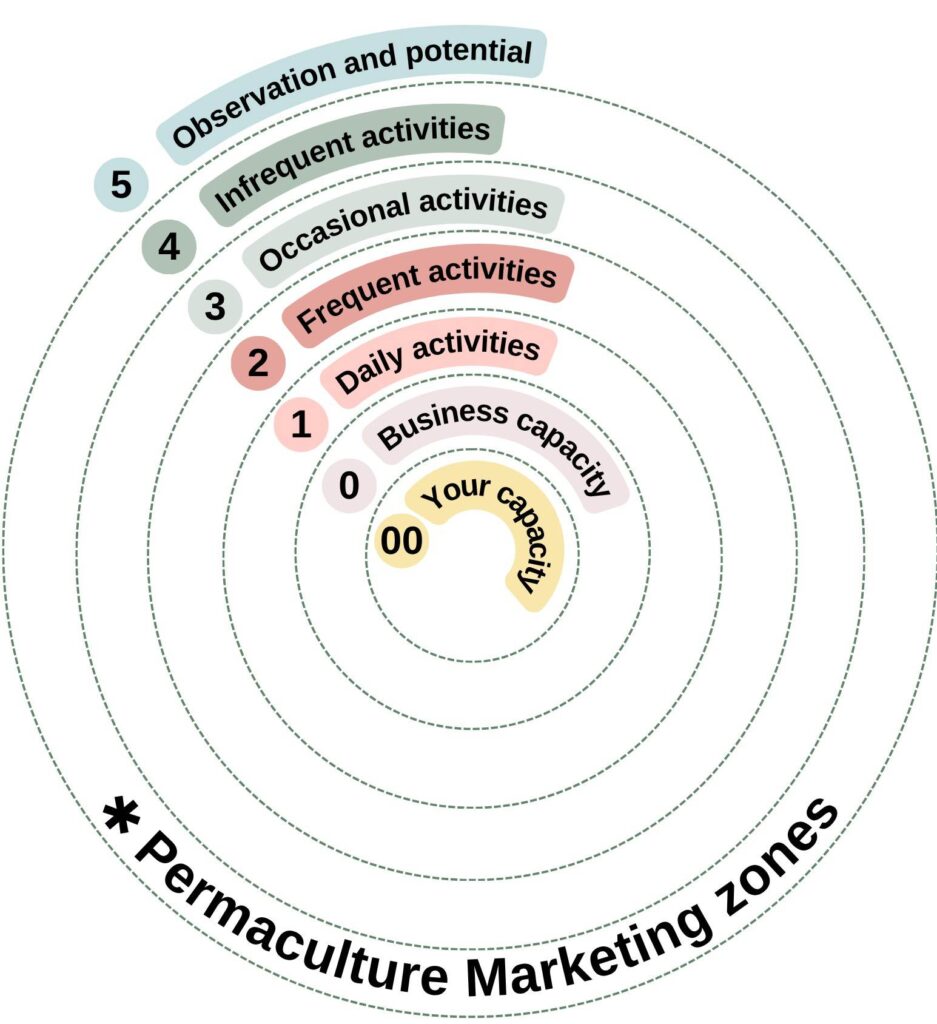
In most permaculture designs, sectors and zones are overlaid onto one map or plan.
This helps you see patterns, interconnections, opportunities and potential challenges, so you can choose marketing approaches that best suit your unique business context.
That’s just a brief, whirlwind sort of brief introduction to using sectors and zones to design your ethical marketing strategy — the full process is explained step by step via videos and fillable workbooks inside my Permaculture Marketing course.
What permaculture thinkers say about this principle
“Pattern literacy enables you to read the world. It is the alphabet, or sign language, of nature and society.” — Rosemary Morrow, Earth Restorer’s Guide to Permaculture
“The trick to doing less is doing more of what we humans do best: use our intelligence to see patterns, create designs and invent things — activities that come so naturally they feel like play. The other side of the coin is to do less of what we do worst. Humans make hard work of digging, but for worms it is fun.” — Linda Woodrow, The Permaculture Home Garden
“Part of permaculture is to look for patterns, to pay attention to the subtle ways nature shows us that the details of our lives that may appear separate are, in fact, interwoven into the fabric of all life.” — Maya Blackwell, Permaculture
“Permaculture design is a system of assembling conceptual, material and strategic components in a pattern which functions to benefit life in all its forms.” — Bill Mollison
✱ You might also enjoy this oldie-but-goodie article, A Pattern Language for Women in Permaculture, by American permaculturist and regenerative business coach, Karryn Olson.
Other closely connected principles
The 12 permaculture principles work best as a set of interconnected design prompts.
Each offers a different lens, and the combination creates depth, balance and a tempering effect — the holistic approach at the heart of systems thinking.
For example, ‘design from patterns to details’ is closely related to:
- Principle 1, ‘observe and interact’, as slowing down to really look first, without judgement, is crucial to spotting and understanding patterns.
- Principle 8, ‘integrate rather than segregate’, which encourages us to identify patterns of needs so we can stack functions, making things multifunctional rather than single-use.
- Principle 9, ‘use small and slow solutions’, as understanding the bigger picture makes it easier to design calmer and more sustainable solutions at the detail level.
Ready for the next principle? Explore permaculture principle 8, ‘integrate rather than segregate’, or browse the full series here.
And a quick side note: this series is adapted from a lesson from inside my Permaculture Marketing course, in case you’d like to go deeper.
Share this with your mates
About the Author: Koren Helbig

About the Author: Koren Helbig