Permaculture principle nine is use small and slow solutions — here’s how it can be used as a practical thinking tool to guide more ethical marketing and business decision-making.
This is Part 10 of a 13-part series: How to Use the 12 Permaculture Principles in Business and Marketing. If you’re new to the principles, start here. Or, you can view the full series here.
What ‘use small and slow solutions’ means
While the permaculture principles were originally developed to guide the design of farms and gardens, they’re actually universally applicable. Let’s look at the traditional definition, then reimagine what ‘use small and slow solutions’ means for ethical business and marketing.
Land-based definition
Make small and considered changes bit by bit to your garden, home and life in a way that’s manageable long-term, instead of overhauling everything at once.
Marketing definition
Implement your marketing strategy slowly, step by step, at a ‘human scale’ that’s doable and effective while respecting the limits of yourself, other people and the planet.
Proverb
Slow and steady wins the race — encourages patience and consistency as we make changes.
Translating this principle to marketing
Much of modern business and marketing is shaped by ‘fossil-fuel scale’ — the ability to move fast and expand constantly thanks to relatively cheap and abundant non-renewable energy.
But in healthy natural systems, unchecked growth is a warning sign that can lead to significant problems and even collapse (think: cancer).
‘Use small and slow solutions’ instead invites us to aim for optimum scale or ‘enoughness’.
This just-right size allows your business to meet your needs without overwhelming resources and ecosystems. It may even deliver a surplus that you can share with others.
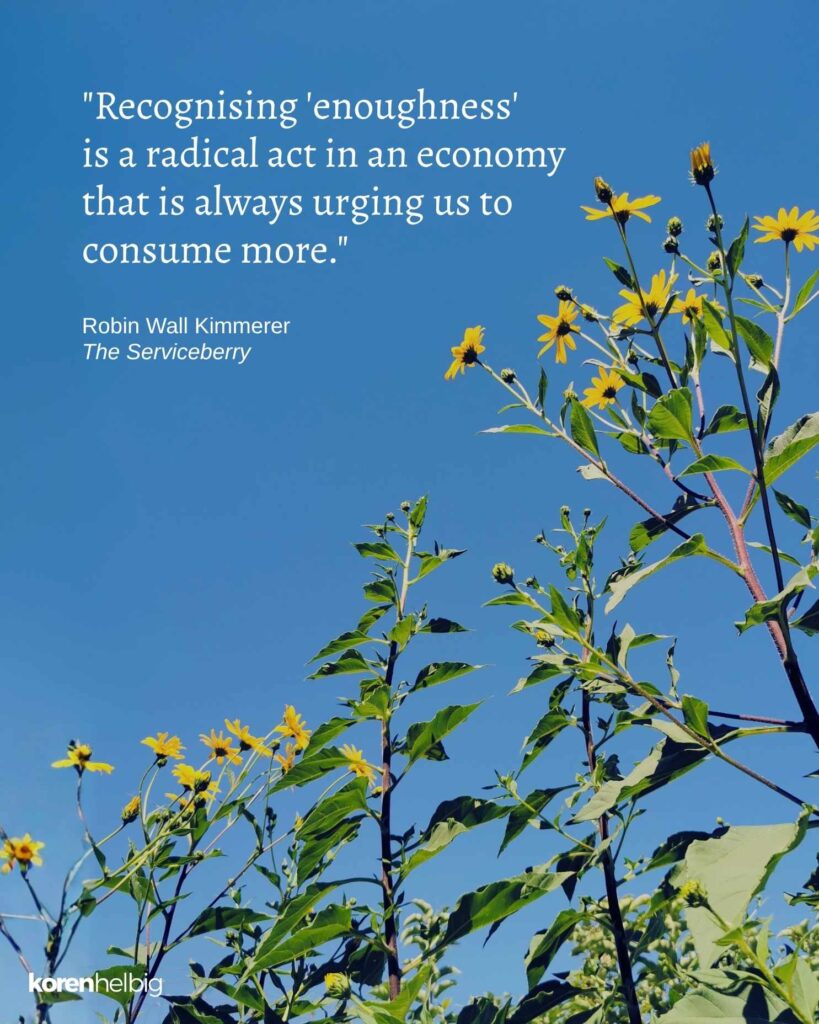
Create right livelihood by embracing ‘enoughness’
‘Enoughness’ is a way to engage with ‘right livelihood‘, the ancient Buddhist concept of making a fulfilling living without harming others.
And it’s closely tied to permaculture’s three ethics of Earth Care, People Care and Fair Share; recognising both planetary limits and your own human capacity.
So, rather than launching five marketing channels, three new offers and a weekly newsletter all at the same time, slow down. Start with just one or two elements, get them stably under control, then incrementally expand.
Operating at this calmer and more sustainable pace — also called ‘human scale’ — means we’re more likely to see the subtle or slower-to-emerge consequences of our actions.
We can then make timely adjustments to minimise negative impacts before they turn into a bigger problem.
Essentially, permaculture principle nine asks us to ditch ‘bigger is better’ thinking in favour of ‘slow is sane’.
How to apply ‘use small and slow solutions’ in marketing
This principle speaks to the heart of one of the biggest problems I see when working with clients.
Too often, small business owners run themselves absolutely ragged trying to be everywhere at once, unable to do things well and sacrificing sales and impact in the process.
‘Use small and slow solutions’ is like a beautiful antidote to all that.
A reminder of enoughness, small steps that add up, being mindful of limits (the planet’s, and our own), and how bigger ain’t always better.
Mimic natural succession
“Make the least change for the greatest possible effect,” permaculture co-originator Bill Mollison urged some 40-odd years ago.
One way to find that sweet spot is by mimicking natural succession — that’s an ecological concept in which ecosystems gradually move from simple to more complex communities over time.
For example, in a land-based context, degraded ground might first be covered by pioneer grasses or even weeds that prepare the soil and create the conditions for more diverse species. Eventually, this can lead to a mature and stable ecosystem, like a forest.
In marketing, you can do something similar by building things in phases, where each stage lays the foundation for the next.
Natural succession for a new business (or when pivoting an existing business), for example, might look like:
- Starting with a small action that creates a base for the future (eg, a simple website).
- Choosing one core customer need and creating one clear offer that meets this need before adding more offers, variations or upsells.
- Introducing one or two primary channels (eg, email marketing and Instagram) to spread the word about your offer.
- Reusing content from your website on your primary channels.
- Gradually adding more webpages, offers and marketing tools, but only as the current ones feel steady, or as more client needs become clear.
- And, most importantly, pruning the stuff that you hate, that isn’t working or that’s becoming too overwhelming.
As Bayo Akomolafe says: “The times are urgent: let’s slow down.”
What permaculture thinkers say about this principle
“Starting small allows you to gradually test ideas, learn from mistakes, and refine your approach. This method reduces the risk of overwhelming yourself and increases the chances of sustainable success.” — Michael Wardle, Savour Soil Permaculture
“Slowing down gives us time to focus on our creativity, when our best ideas might emerge — to move past the initial ‘good’ ideas to something much more exciting and dynamic.” — Wilf Richards, The Power of Permaculture Principles
“Small systems are easier to maintain… Implement the priorities that create a base for the future… This process is slower, but over a long period of time it produces much better and more stable results.” — Lachlan McKenzie and Ego Lemos, Tropical Permaculture Guidebook
“…There is a big difference between choosing to go faster when doing so genuinely brings benefit and being caught in a pattern of hurry through habit or demand. Because the valuing of speed is so embedded within our society, most people end up feeling so rushed and so short of time that their life becomes one long race.” — Chris Johnstone and Joanna Macy, Active Hope
“We need to wean ourselves from the belief that multitasking is an achievable way of working. It isn’t. Multitasking just means doing more things more badly. People who multitask by frequently checking their email suffer a reduction in intelligence equivalent to exhaustion or smoking marijuana.” — Rob Hopkins, From What Is to What If
“Slow productivity emphatically rejects the performative rewards of unwavering urgency. There will always be more work to do. You should give your efforts the breathing room and respect required to make them part of a life well lived, not an obstacle to it.” — Cal Newport, Slow Productivity
Other closely connected principles
The 12 permaculture principles work best as a set of interconnected design prompts.
Each offers a different lens, and the combination creates depth, balance and a tempering effect — the holistic approach at the heart of systems thinking.
For example, ‘use small and slow solutions’ is closely related to:
- Principle 1, ‘observe and interact’, as it’s easier to choose the right solutions or next steps when we first pause to understand real needs and challenges.
- Principle 4, ‘apply self-regulation and accept feedback’, as working at ‘human scale’ requires deep listening to yourself and others around you.
- Principle 8, ‘integrate rather than segregate’, as we can create a thriving business from a smaller kit of marketing tools when they’re each chosen to work together in beneficial relationships.
Ready for the next principle? Explore permaculture principle 10, ‘use and value diversity’, or browse the full series here.
And a quick side note: this series is adapted from a lesson inside my Permaculture Marketing course, in case you’d like to go deeper.
Share this with your mates
About the Author: Koren Helbig

About the Author: Koren Helbig