Trying to make ethical choices in business and marketing can often feel like a minefield.
We may set out with the best of intentions, only to be buried beneath an avalanche of options, prices and functional considerations, none of which constitute the ‘perfect’ choice.
The risk is overwhelm and analysis paralysis. As it all gets too complicated, we may default to the easiest option — ethics be damned.
Allow me to offer the 12 permaculture principles as an alternative pathway to smart and ethical decision-making.
This is Part 1 of a 13-part series: How to Use the 12 Permaculture Principles in Business and Marketing. You can view the full series here.
Thinking tools based on the patterns of nature
The permaculture principles are practical thinking tools, based on the patterns of nature, that can help you consider and make more sustainable decisions in any area of your life and work.
While the principles have traditionally guided the design of permaculture farms and edible gardens, they’re not only limited to land-based systems and lifestyles.
They’re actually universally applicable. So, they’re brilliant as actionable guidelines for ethical business and marketing decision-making, at any scale and in any context.
Let’s explore the 12 permaculture principles in depth, including what they mean and how they can help small business owners, sole traders, entrepreneurs and impact-driven businesses create values-aligned marketing strategies that benefit all.
A systems-thinking approach to making holistic marketing decisions
One of the things I love most about the permaculture principles is that they’re not a reductionist, one-size-fits-all approach, nor a rigid blueprint that you have to follow in a specific way.
Instead, they’re like a choose-your-own-adventure map that responds to your unique situation, helping create a plan that works for your context.
Think about it from a gardening perspective: you wouldn’t expect the same garden plan to work in Australia as in Thailand, given their very different climates, soils and ideal plant types. And even within the same country or city, the “right” garden depends on who’s holding the tools, and how much time, energy, mobility and motivation they have.
It’s the same for business and marketing.
Just like a garden, your marketing exists within a system shaped by your unique human capacity, skills and business model, as well as your wider business purpose, the needs of the community you serve and the planetary limits we all live within.
The permaculture principles help you design in relationship with all of that, rather than trying to optimise one marketing part in isolation.
This is called systems thinking.
Essentially, the permaculture principles translate the patterns of nature into a practical framework for designing both living systems (plants, animals, etc) and non-living systems (marketing, businesses, etc) in sustainable and resilient ways.
Thus, as a holistic thinking tool, the permaculture design principles are an excellent fit for any business that values the quadruple bottom line: purpose, people, planet and profit.
They’re especially helpful for small businesses and sole traders, I reckon — folks like us often have more capacity to be agile, considered and intentional in ethical decision-making.
And a quick side note: this series is adapted from a lesson from inside my Permaculture Marketing course, in case you’d like to go deeper.
A brief history of the permaculture design principles
Much of permaculture theory is inspired by and draws on ancient wisdom and indigenous knowledges, and the principles are no exception.
Almost every concept contained within them would have been learned or applied in some indigenous context at some point — and so, as Heather Jo Flores writes, the ideas within permaculture’s principles are not created or owned by any permaculturist, but rather are “ecological truths, and we learn them so we can work with rather than against nature”.
Permaculture itself was first conceptualised in the 1970s by Australians Bill Mollison and David Holmgren, and the movement has always held design principles at the heart of its teachings.
But, somewhat confusingly, multiple sets of permaculture principles have been developed over the years.
- Bill Mollison created the first permaculture principles in 1988.
- Bill Mollison and Reny Mia Slay offered an updated set of permaculture principles in 1991.
- David Holmgren created a refined set of 12 permaculture principles in 2003.
- Multiple permaculture designers have since tweaked or added to these, or even come up with their own new sets of principles. This list provides a solid overview of the many ecological design principles scattered across permaculture books.
- Sarah Queblatin has advocated for the addition of Principle 0, centring indigenous local wisdom and indigenous people in permaculture design and decision-making.
All of these remain relevant and useful today, especially Principle 0.
But many permaculture teachers, myself included, tend to focus on David Holmgren’s 12 design principles, as they are a little clearer and more fulsome as an interconnected framework.
Holmgren positions his principles as tools for navigating complexity (Permaculture: Principles and Pathways Beyond Sustainability):
“In attempting to lead an ethical life, we need conceptual tools that will allow us to find what is appropriate, is practical for the situation and context, and yet will have some enduring value in chaotically challenging times. Permaculture, and especially permaculture design principles, are conceptual tools which many people are finding useful in this journey,” Holmgren writes.
What are the 12 principles of permaculture?
David Holmgren’s 12 permaculture principles, created in 2003, are:
- Observe and interact
- Catch and store energy
- Obtain a yield
- Apply self-regulation and accept feedback
- Use and value renewable resources and services
- Produce no waste
- Design from patterns to details
- Integrate rather than segregate
- Use small and slow solutions
- Use and value diversity
- Use edges and value the marginal
- Creatively use and respond to change
Much has been written about how to apply these principles to landscapes and gardening. I’ve focused on reimagining and refocusing each definition on how it can be applied to ethical marketing.
Click on each principle above to explore key definitions and practical examples of how to apply them to your business and marketing design and decision-making, or view the full series here.
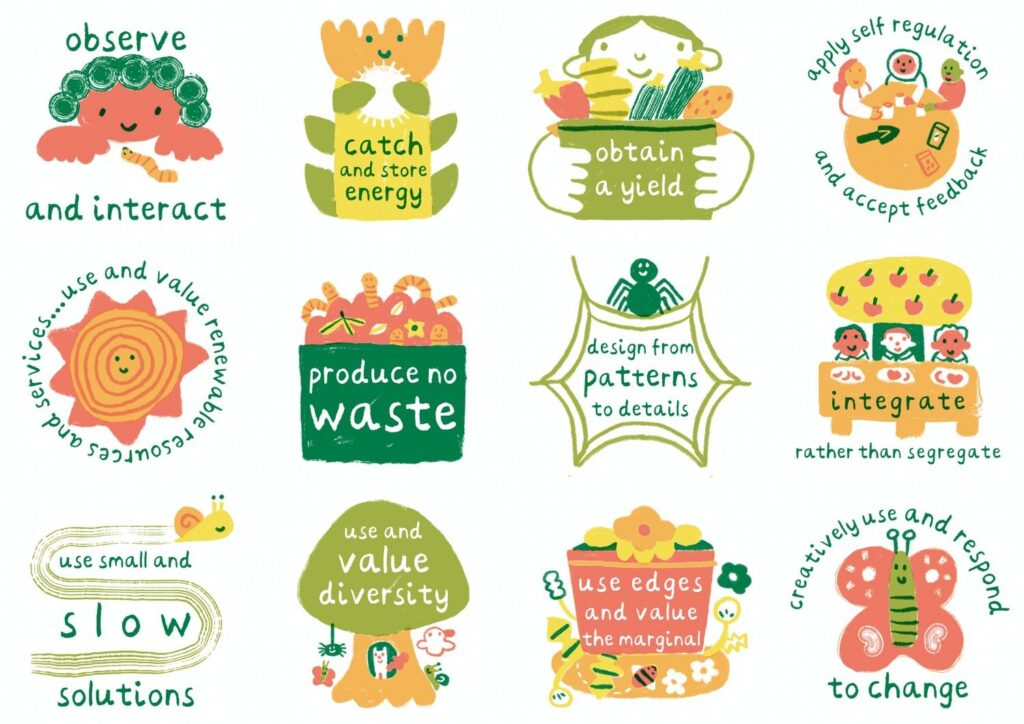
How to use the 12 permaculture principles in business and marketing
The easiest way to work with the 12 permaculture principles is to keep them in front of you whenever you’re making business and marketing decisions. Use them as thinking tools that help you consider multiple angles, impacts and possibilities.
They’re like a checklist — but not in the sense that every marketing action must tick every principle’s box.
They work best as a set of interconnected design prompts. Each principle offers a different lens, and it’s the combination of lenses that creates depth and balance.
When faced with a particular marketing problem or opportunity, you could:
- Begin with principle one, asking yourself what perspectives or solutions it offers.
- Progressively work your way through all 12 principles, repeating that same question.
- Lastly, ask yourself how many of these ideas you could embed into your next steps.
This process isn’t a growth hack or a quick tip. It’s quite the opposite. In fact, using the permaculture principles as a thinking tool and decision-making framework might at first feel more confusing than whatever you’re currently doing.
But I gently encourage you to stick with it.
As your familiarity with the principles grows, the whole system becomes clearer and more useful. Over time, you start naturally referring to them almost without thinking. It’s like a muscle you strengthen with repeated training.
Having said that, working with the principles also doesn’t have to be exhaustive or time-consuming. Even just skimming the list of principles can help spark new perspectives and ideas.
Be aware that applying just one principle, without considering the others, can actually lead to dysfunctional or even unethical outcomes.
That’s because the principles are interconnected and designed to balance and temper one another — a holistic approach that lies at the heart of whole systems thinking and design.
In general:
- The first six principles take a ‘bottom-up’ approach, looking at the individual parts of a system.
- The last six principles take a ‘top-down’ view, stepping back to look at the bigger picture of the system as a whole.
How the principles interact with the permaculture ethics
You might also be familiar with the three permaculture ethics of Earth Care, People Care and Fair Share, which are also heavily influenced by indigenous knowledges and ancient wisdom.
These ethics sit beneath the permaculture principles, acting as a core moral foundation or true north.
- The 3 ethics are an overarching moral code, grounded in ancient wisdom, that are deliberately high-level and broad. To apply them in day-to-day life, we need a more detailed toolkit.
- The 12 permaculture principles are practical thinking tools that help you test ideas and make good decisions, ensuring any real-world action you take aligns with the three ethics.
In other words, ethics are the ‘why’ or foundational moral code, whereas principles are the ‘how’ or tools for designing functional marketing systems.
Actionable guidelines for ethical marketing decision-making
I apply the permaculture principles almost daily in my own small business and regularly with my clients, too.
Keeping the principles in mind when making marketing decisions helps create more holistic, nature-informed, regenerative and locally relevant solutions that bring in profit while also supporting your purpose and benefiting people and the planet.
This helps us sidestep the many awful trappings of conventional marketing — the hustle culture and rushing, the force and manipulation, and the fallacy of endless growth.
It offers what I call a ‘practical idealist’ approach, helping create a marketing system that’s mutually beneficial to all while being grounded in the reality of the imperfect and resource-limited world we live in.
An interconnected system that gradually creates kinder marketing
Once you develop a deeper understanding of the 12 permaculture principles, you’ll start to notice how much they overlap, intersect and reinforce one another.
That’s deliberate. Because, just like a healthy ecosystem — and any system, really, living or otherwise — the principles’ real strength lies in the relationships between the parts, not in any single principle on its own.
“The whole is greater than the sum of the parts,” as Aristotle said.
When applied to marketing, the 12 principles of permaculture encourage us out of conventional, reductionist approaches — where each marketing tool or tactic is tackled in isolation — and into a more holistic mindset guided by systems thinking.
This is not a done-overnight thing, obviously. Or a done-once-and-never-again thing either.
But gradually, bit by bit, your marketing becomes more holistic, human, kind and considerate, which in turn gradually helps your small business become more resilient and sustainable too.
Ready to explore each of the 12 permaculture principles in more detail? Browse the full 13-part series.
One last word from me: This series is the big-picture theory, paired with broad examples to spark new ways of thinking.
Inside the Permaculture Marketing course, we go much deeper, exploring ways to apply the permaculture principles to key marketing elements, from planning strategy to choosing platforms and knowing what to say, where.
Helpful extra resources and links
- Essence of Permaculture by David Holmgren — a free downloadable 32-page booklet summarising the permaculture concept and principles.
- Permaculture: Principles and Pathways Beyond Sustainability by David Holmgren — a much more detailed look at the permaculture ethics and principles (though largely discussed through a landscape and household management lens).
- Decolonising Permaculture with Principle Zero — Rosemary Morrow in Conversation with Sarah Queblatin, on designing with a new principle that recognises local wisdom and ensures indigenous people are included in decision-making.
- Exploring the Permaculture Principles: Wilf Richards with Morag Gamble — a podcast about how the permaculture principles have evolved since the 1970s.
- Applying the design principles in business —Transition Network co-originator Rob Hopkins steps through ideas for all 12 principles of permaculture.
- Permaculture and Money — regenerative money coach Laura Oldanie on how to apply the principles to personal finance, including ideas for permaculture small businesses and right livelihoods.
- What sustainable businesses can learn from permaculture —practical ideas for how to apply Holmgren’s principles, by Dutch B Corp consultant Eva Schouten.
- How To Permaculture Your Business — ways to apply David Holmgren’s 12 permaculture principles in business, by Western Australian permaculture business coach Bronwyn Chompff-Gliddon.
- 12 Permaculture Design Principles For Small Business — ways to apply Bill Mollison’s 12 principles, by Australian trainers, Permaculture Visions.
- Embedding Permaculture Principles and Design into a Business — how The Green Woman co-founders practically apply permaculture design principles across their small UK organic toiletries business.
- The 12 principles of permaculture for websites — a blog post series on using the 12 principles to guide web design, by Berlin agency AllCodesAreBeautiful.
- The CERES Principles — the world’s first corporate code of environmental conduct, encompassing 10 principles developed in 1989 by the Coalition for Environmentally Responsible Economies.
Share this with your mates
About the Author: Koren Helbig

About the Author: Koren Helbig