Permaculture principle five is use and value renewable resources and services — here’s how to use it as a practical thinking tool to guide more ethical marketing and business decision-making.
This is Part 6 of a 13-part series: How to Use the 12 Permaculture Principles in Business and Marketing. If you’re new to the principles, start here. Or, you can view the full series here.
What ‘use and value renewable resources and services’ means
While the permaculture principles were originally developed to guide the design of farms and gardens, they’re actually universally applicable. Let’s look at the traditional definition, then reimagine what ‘use and value renewable resources and services’ means for ethical business and marketing.
Land-based definition
Make the best use of nature’s abundance, such as sun and wind, to reduce over-consumption and reliance on non-renewable resources while meeting your needs.
Marketing definition
Prioritise marketing tools that run on renewable resources, and ways of working that replenish rather than deplete people, nature and your own capacity.
Proverb
Let nature take its course — reminding us that attempting to control natural patterns via excessive tech or resource use can be expensive and negatively affect the environment.
Translating this principle to marketing
Right now, it’s difficult — if not impossible — to fully divorce marketing from at least some reliance on fossil fuels and other non-renewable resources, especially given the tech boom underpinning digital marketing.
About the best we can aim for is reducing our impact.
For example, most websites are powered by fossil fuels — but you could switch yours to one of the small yet growing number of website hosting providers running on 100% green energy.
When choosing lower-impact marketing tools and platforms, the key is to take a lean and minimalist mentality, prioritise people over tech and consider impacts on the planet and more-than-human world.
A “perfect” solution may not exist, but a better one often will.
We must also pay attention to the worrying lack of ethics increasingly displayed by tech oligarchs and switch to supporting emerging environmentally responsible alternatives where possible.
Vote for renewables with your dollar
Another practical application of ‘use and value renewable resources and services’ involves mindfully choosing who you work with and buy from, and even how you store your money.
Money makes the world go round, as they say — yet many major banks and investment funds continue to invest in fossil fuel companies and their coal, oil and gas projects, driving global warming.
Instead, we can fund renewable approaches by choosing more ethical, climate-positive banks and financial institutions, and by supporting businesses committed to the quadruple bottom line: purpose, people, planet and profit.
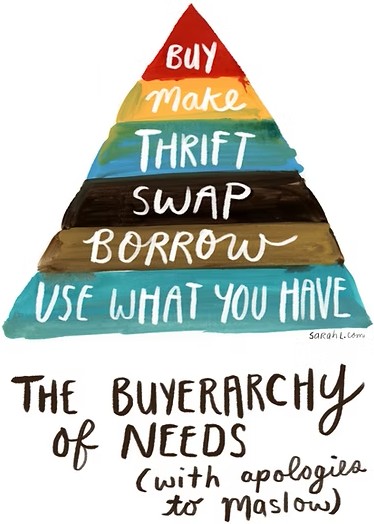
But even before spending money, you might pause to consider the ‘Buyerarchy of Needs‘ by Sarah Lazarovic. The most sustainable thing is often the item you already own because of the embodied energy that goes into making something new.
Open your mind to other forms of renewable resources
From there, the challenge is to widen your concept of what ‘renewable resources’ are.
Think of things that can be regenerative when respected and cared for, but deplete quickly when overused or taken for granted.
This includes trust and goodwill in the community, support from collaborators and suppliers, your team’s willingness — and even your own creativity, enthusiasm and health.
“Our degree of enthusiasm can act as a guide, like an inner compass, that helps us steer toward the sort of activity we’ll want to stick with in the long term. We are more effective when acting from our strengths and enthusiasm.”
— Joanna Macy and Chris Johnstone, Active Hope
How to apply ‘use and value renewable resources and services’ in marketing
I see two key ways to apply permaculture principle five in a business and marketing context: by making mindful choices around both tangible and intangible resources.
Tangible renewable marketing resources
- Energy: Look for ways to reduce your energy needs, and power your website, office and devices with renewable energy sources such as solar, wind or hydro.
- Tools: Consolidate to the fewest lightweight, multi-purpose platforms, reducing data storage and energy demand. (Here’s a giant list of the mindfully chosen tech, finance and marketing tools I use.)
- Suppliers: Work with people and companies that actively consider environmental and social impact alongside profit (eg, B Corps, permaculturists).
- Materials: Use compostable, recyclable or reusable materials for packaging, print and physical products; design for durability, repair and reuse.
- Money: Aim to operate primarily from income rather than depleting savings, choose ethical banks and super funds, and reinvest into regeneration (eg, 1% for the Planet).
Intangible renewable marketing resources
- You: Treat your health, motivation and creativity as renewable assets that require rest, nourishment, boundaries and recovery to stay productive.
- Other people: Skills, care, collaboration and shared knowledge are renewable when relationships are respectful, fairly compensated and not extractive.
- Time: Protect your time and energy by designing a Minimalist Marketing Toolkit — the smallest, leanest set of platforms and practices that reliably help people discover you, trust you and buy from you.
What permaculture thinkers say about this principle
“Being mindful of our use of something that naturally regenerates, we can use it indefinitely. That long view that stretches beyond our own life horizon, to allow generation after generation to have access to the surpluses we can build in this lifetime.” — Scott Mann, The Permaculture Podcast
“We can broaden the concept of renewable resources to include things like goodwill and trust… in the form of repeat customers and sustained business partners. Trust is at the heart of success in business, and it is very much a renewable resource.” — Jason Thomas, Regeneration Nation Costa Rica
“People are renewable resources, and we need to value and use their input.” — Looby MacNamara, People and Permaculture
“Money can be a renewable resource when we put it into well-chosen assets and investments.” — Laura Oldanie, Permaculture and Money
“Doing an imperfect something is better than doing a perfect nothing.” — Toby Hemenway, Gaia’s Garden
Other closely connected principles
The 12 permaculture principles work best as a set of interconnected design prompts.
Each offers a different lens, and the combination creates depth, balance and a tempering effect — the holistic approach at the heart of systems thinking.
For example, ‘use and value renewable resources and services’ is closely related to:
- Principle 2, ‘catch and store energy’, as working with renewables often requires an understanding that energy comes in pulses that we can catch and store for later use.
- Principle 8, ‘integrate rather than segregate’, as a Minimalist Marketing Toolkit relies on fewer platforms, each strategically selected so they help and support one another.
- Principle 10, ‘use and value diversity’, as prioritising lower-impact tech and marketing tools often means supporting platforms at the fringes, rather than Big Tech.
Ready for more? Explore permaculture principle 6, ‘produce no waste’, or browse the full series.
And a quick side note: this series is adapted from a lesson from inside my Permaculture Marketing course, in case you’d like to go deeper.
Share this with your mates
About the Author: Koren Helbig

About the Author: Koren Helbig