Permaculture principle six is produce no waste — here’s how it can be used as a practical thinking tool to guide more ethical marketing and business decision-making.
This is Part 7 of a 13-part series: How to Use the 12 Permaculture Principles in Business and Marketing. If you’re new to the principles, start here. Or, you can view the full series here.
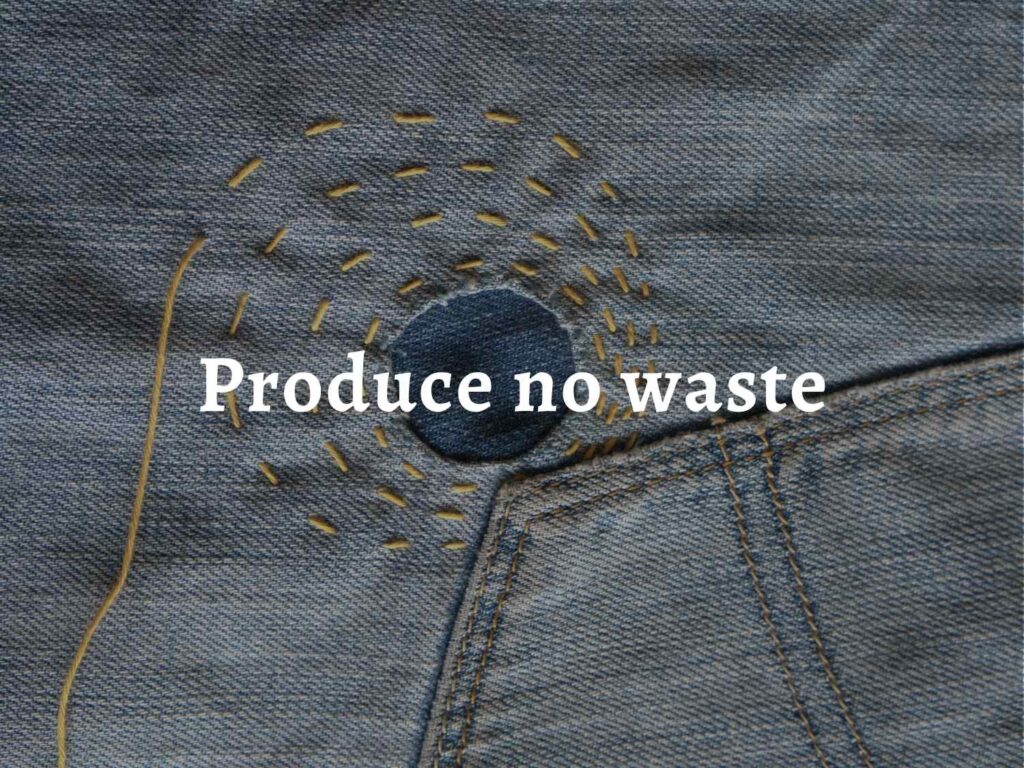
What ‘produce no waste’ means
While the permaculture principles were originally developed to guide the design of farms and gardens, they’re actually universally applicable. Let’s look at the traditional definition, then reimagine what ‘produce no waste’ means for ethical business and marketing.
Land-based definition
Minimise waste and pollution by designing circular systems that mimic nature, where the output of one element becomes the useful input for another.
Marketing definition
Choose marketing systems that minimise waste of resources, time and energy, and prioritise reducing, reusing and timely maintenance as much as possible.
Proverbs
A stitch in time saves nine, which highlights the importance to timely maintenance to prevent waste.
Waste not, want not, which reminds us it’s easy to be wasteful in times of abundance, but this waste can cause later hardship.
Translating this principle to marketing
In healthy natural systems, waste doesn’t exist — the output of one element becomes a valued input meeting another’s needs, and so the closed-loop wheel of life continually turns.
In contrast, modern extractive systems are built on disposable culture and a ‘take, make, dispose’ economic model. This treats waste and pollution as unavoidable byproducts.
‘Produce no waste’ encourages us to reframe “waste” as a resource that hasn’t yet been properly utilised — and therefore a potential opportunity, or even a source of abundance.
Prioritise the ‘Five Rs’ of waste management
Realistically though, it’s near-impossible to create a completely circular, closed-loop marketing system in today’s world, especially given the fossil fuel-driven tech boom underpinning digital marketing.
But we can at least produce less waste with mindful choices, guided by the five Rs: refuse, reduce, reuse, repair and recycle.
For example, many businesses blast thousands of people with junky sales emails each week, which is disrespectful (a waste of your community’s trust and goodwill) and contributes to unnecessary data storage and digital pollution.
Instead, you could send fewer, higher-value emails, remove unnecessary automated emails and proactively prune inactive subscribers to reduce digital waste.
Use proactive maintenance to prolong lifespans
Just as important, but often overlooked, is the timely maintenance of systems, tools, platforms and processes.
These naturally degrade over time, a concept known as entropy.
But with regular review and upkeep — done before things break — you can extend their lifespan, while also reducing the work involved in major repair and restoration.
This might look like setting an annual reminder to check all your email automations from beginning to end, ensuring the content, messaging and links are up to date. Or installing a broken link checker plugin on your website, so you get regular reports about dead links.
Consider stress and wasted time as a ‘pollutant’
From there, we can expand our thinking beyond the material world to consider other intangible forms of waste.
What if you labelled stress and wasted time, skills and energy as a ‘pollutant’ in your business? How might that influence your approach to these ‘leaks’?
By changing the lens through which we view intangible waste, we might discover the motivation to more carefully manage and reduce them.
How to apply ‘produce no waste’ in marketing
You can use ‘produce no waste’ as a practical thinking tool to consider multiple angles, impacts and possibilities in your business and marketing. For example:
- Reframe waste as a resource: Embrace circular thinking and look for ways that “waste” can become a yield for your business or someone else’s (“the problem is the solution,” as permaculture co-originator Bill Mollison said).
- Design out waste at the source: Consider conducting an environmental impact audit of your business operations and marketing tools, content and systems.
- Apply the five Rs: Refuse, reduce, reuse, repair, recycle — remembering that recycling is the last resort, not the first option.
- Design for reuse: Create reusable products and modular content or offers that can be adapted, repurposed or easily retired over time.
- Keep assets in use for as long as possible: Maintain, repair and update existing tools, content and offers — the most sustainable option is often what you already have.
- Consider intangible waste: Notice leaks in time, energy, attention, skills and knowledge (eg, outdated offers, unnecessary admin, doom-scrolling habits).
- Ask yourself how you could do more with less: Apply frugal creativity to your marketing, borrowing ideas from my favourite book, The Art of Frugal Hedonism.
What permaculture thinkers say about this principle
“There’s no such thing as waste. There are only misdirected resources and poorly designed systems. Waste would seem to be yet another manifestation of abundance.” — Laura Oldanie, Permaculture and Money
“Once we consider something to be valuable, we’re far less likely to waste it unnecessarily… the aim is to step away from the pernicious consumerist thinking that capitalism grooms us to hold, and reframe our thinking so we want less and value more.” — Anna Matilda, Everyday Permaculture
“Ironically the gift of oil has made us far more wasteful of energy, something our ancestors would never have done for long. We’ve used fossil fuels to replace skill with brute force in so many areas.” — Aranya, Permaculture Design
“Eliminating waste is the least-effort path to creating abundance and should be done first… How do we trim waste wisely? Much of it can be done simply by performing that primary permacultural activity, the observation step.” — Toby Hemenway, The Permaculture City
Other closely connected principles
The 12 permaculture principles work best as a set of interconnected design prompts.
Each offers a different lens, and the combination creates depth, balance and a tempering effect — the holistic approach at the heart of systems thinking.
For example, ‘produce no waste’ is closely related to:
- Principle 1, ‘observe and interact’, as often it’s only by pausing and taking the time to really look that we can understand where waste might be occurring.
- Principle 4, ‘apply self-regulation and accept feedback’, which reminds us that the negative impacts of today’s waste might only be realised much further down the track.
- Principle 5, ‘use and value renewable resources and services’, which encourages us to seek alternatives to fossil fuels and other wasteful single-use items.
- Principle 12, ‘creatively use and respond to change’, which asks us to make deliberate use of change and reduce waste in areas where we have control and influence.
Ready for the next principle? Explore permaculture principle 7, ‘design from patterns to details‘, or browse the full series here.
And a quick side note: this series is adapted from a lesson from inside my Permaculture Marketing course, in case you’d like to go deeper.
Share this with your mates
About the Author: Koren Helbig

About the Author: Koren Helbig