A permaculture design process helps you turn goals or ideas into real-world action and ongoing improvement, in a way that aligns with your ethics and values.
It can guide you toward better decisions and more rigorous plans in any area of your life, from your work or business to your home, garden, community and beyond.
But many well-known permaculture design processes require memorising long streams of acronym letters that I’ve found hard to recall off the top of my head.
So, after a decade of permaculture experience and deep learning, I created a simplified version.
It’s called ODII, and it has four steps: Observe, Design, Implement, Iterate.
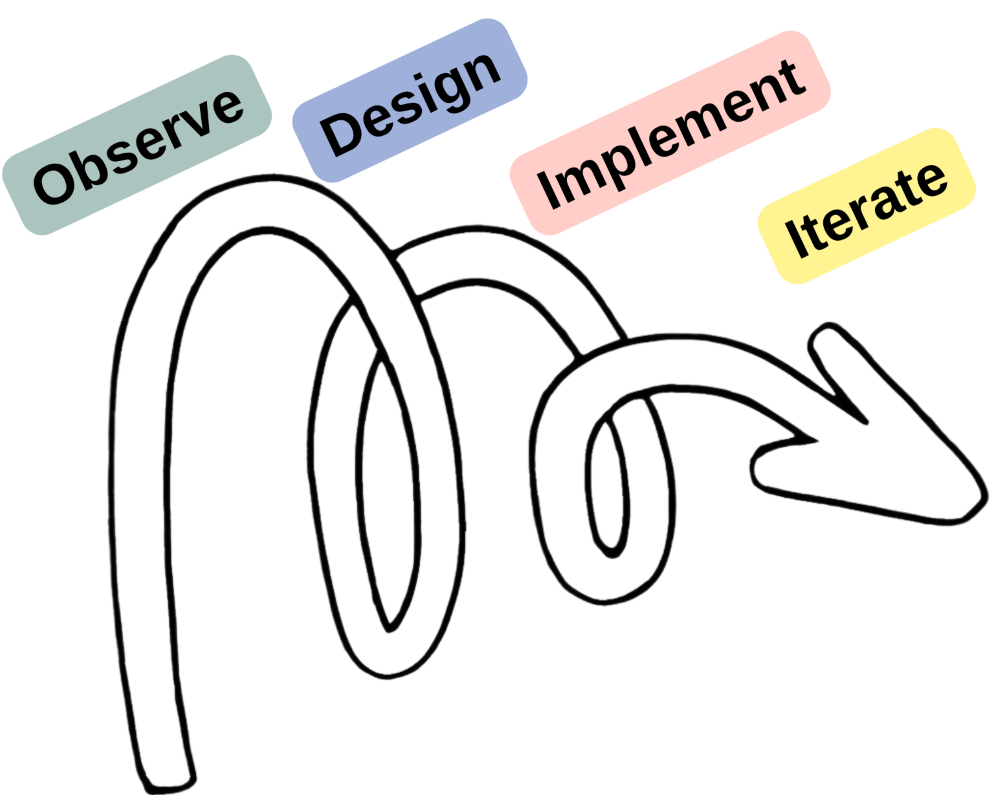
ODII is modelled on the way all humans naturally learn through experience and mirrors the spiral, a key pattern in nature that circulates energy and gradually builds.
This article walks you through the whole process, including reflection questions and permaculture tools to help you get the most out of each ODII step, and two free ‘getting started’ downloadable resources.
What is the ODII Design Spiral?
ODII is a simple four-step permaculture design process created for people wanting to make changes not just in your garden, but beyond it too — in small businesses, marketing, homes, communities and life.
This process can take as little as 10 minutes for a quick decision, such as what to post on social media or what veggies to pick and eat for dinner. Or it can roll out over months or even years for bigger projects and decisions, such as launching a website or rebuilding your entire garden.
| Step | What’s involved |
| Observe | Set your vision, then slow down and pay attention to what is. |
| Design | Create a clear plan for how you’ll make changes. |
| Implement | Take action. |
| Iterate | Pause, reflect and learn from your experience. |
ODII works best when approached as an ever-evolving cycle.
You rarely move through it just once and call it complete. Most often, you arrive at the iteration stage, only to start observing again – each time from a slightly wiser and more informed place.
This is why I refer to this process of permaculture design as a spiral.
Modelled on how we naturally learn
ODII mirrors the Action Learning Cycle, which, helpfully, is how all humans naturally learn.
It’s learning from experience, a process we all innately know (even if we’re not consciously aware of it), as it’s how we pick up most things in life.
For example, learning to walk often looks like this:
- Observe: You first watch adults walking. How are they doing that?
- Design: You think about it. How will I have a go at that myself?
- Implement: You get up off the ground, try to take a step, and likely fall over.
- Iterate: You think: What went wrong? What could I do differently?
- Then you start again with more observation and more design.
It’s a continuous spiral, creating a progressive process of growth and learning.
The ODII permaculture design process reminds us to consciously move through each step as we make plans and take action, in a self-directed and nature-informed way.
Mirrors a key pattern in nature
At the heart of permaculture lies pattern recognition — understanding patterns commonly found in nature and using them to design sustainable human systems. (Similar to biomimicry.)
In a fairly mind-boggling quirk of nature, the vast complexity of life boils down to about the same eight patterns that repeat over and over, from the tiniest quantum scale to our gigantic cosmos.
Among those eight natural patterns is the spiral.
Think: snail shells, pine cones, whirlpools, the Fibonacci sequence, even our microscopic DNA structure and the enormous expanse of entire galaxies… and, of course, ODII. 🌀
The spiral pattern is one of nature’s most efficient designs. It tends to circulate energy, gradually improve, expand exponentially and build on success, all while anchored to a foundational core.
It’s a beautiful, powerful pattern to weave into your business and marketing, and throughout your life, home and garden.
The four steps of the ODII permaculture design process
Step 1: Observe
Goal: Set your vision, then slow down and pay attention to what is.
Core question: What’s actually going on here?
Before doing anything, pause. Consider your end goal. Then look within yourself and at your business, garden, life or whatever project you’re focusing on, and take stock of what’s currently happening. Gather information that can help you see the situation more clearly — both the physical, tangible, analytical stuff and the more internal, intangible, mental or gut-feel signals. Momentarily suspend the need to solve or do, and just get curious.
Ask yourself:
- What is my end goal or broad vision? What am I trying to achieve?
- What needs come up when I think about this goal or vision, including my own and those of stakeholders and the more-than-human world? How are these needs currently being met?
- What patterns can I see? Zoom out to the bigger picture, zoom in to the details.
- What’s working well right now, and what’s struggling, stagnant or not reaching target?
- What do the facts, stats, key performance indicators and other hard data tell me?
- What are my hopes and desires for this? What am I worried about or don’t want to happen?
- Is this feeling good or yuck? Am I happy and energised or bored and flat?
- What little whispers are coming through? How does my body feel when I think about this?
Step 2: Design
Goal: Create a clear plan for how you’ll make changes.
Core question: What do I want, and what’s the simplest way to get there?
Based on what you’ve observed, sketch out a plan before moving into action. This is deep thinking time: working out what to focus on, in what order and how. A rough plan or map gives you guidelines to follow so you’re less likely to get lost down rabbit holes. It might also involve action in a place not yet visible to the public or other people, such as a first draft, which is easier to change than something that’s already live.
Ask yourself:
- What are my options for reaching my goal or vision? Which feels most realistic and aligned?
- What’s the simplest path forward that meets the most important needs?
- How could I ‘stack functions’ to better meet needs or get more uses out of each element?
- How could I maximise beneficial relationships between people or things?
- What do I need to do first, then next? What could wait until later?
- Who does what, and by when?
- What tools, systems or structures do I need to make this happen?
- How will I track progress so I can see how things are going?
- Does this plan align with my ethics and values, and my earlier observations?
Step 3: Implement
Goal: Take action.
Core question: How can I sustainably get this done?
Finally, it’s time to act. Take incremental steps toward your goal or vision. Make or do the thing, put it out into the world. Let others see your thoughts, ideas, words, creations, products, services; whatever you’ve been dreaming up. Maintain momentum and see things through to completion, while staying open to feedback and necessary course corrections as you go.
Ask yourself:
- How can I take action in a way that’s realistic for my current capacity?
- How can I make progress visible to help maintain momentum?
- Do I need to bring in any help, support or allies?
- Are core needs being met as I go, including my own and those of stakeholders and the more-than-human world?
- What early feedback am I getting, and are any small tweaks needed?
- Am I remaining aligned with my original goal or vision and my ethics and values?
Step 4: Iterate
Goal: Pause, reflect and learn from your experience.
Core question: What happened and how could I improve for next time?
Pick a good moment to evaluate your actions. It might be time-based (monthly, quarterly), project-based (when something wraps up), market-based (sales or client needs are shifting) or even feelings-based (“I’m no longer enjoying this and want to know why”). Noticing any effects helps you avoid repeated mistakes and build on success, while realigning to your vision and progressively improving with ever-deepening wisdom, awareness and knowledge.
Ask yourself:
- Did my actions align with my vision and plan, and are they having the intended effect?
- What worked really well versus what didn’t and may need tending, pruning or composting?
- What did I not end up doing, and why?
- Did this work feel sustainable or draining?
- What feedback did I receive from stakeholders, stats and data, and my own internal world?
- What did I learn, and what would I do differently next time?
- Where did I stray from my ethics and values, and how could I avoid this in future?
- What learnings will I take into the Observe stage, as I turn the spiral anew?
Free download: A guide to each ODII step
Want a quick-reference sheet? This short PDF guide covers the four ODII steps above, plus common permaculture tools you can use at each one to deepen your thinking.
The guide is printer-friendly and free (no email details needed to access this, just click and you’ll have it).
⬇️ Quick reference guide – The ODII Design Spiral
How I created the ODII permaculture design process
Many early permaculture design processes were landscape-focused, aimed at designing farms, gardens and properties. In more recent decades, attention has turned to processes that support good design beyond the garden gate.
ODII adds to that body of work, and I’m particularly interested in how it can help create more ethical businesses and marketing in any industry.
In developing this new permaculture design process, I’ve been influenced and inspired by a wide range of people, modalities and experiences, including:
- Studying my Permaculture Design Certificate in 2017.
- Integrating permaculture into my marketing work with 200+ ethical small business owners.
- A decade of applying permaculture design in my own city garden and in friends’ gardens.
- Reading widely about permaculture, both the seminal originals such as Bill Mollison’s Permaculture: A Designer’s Manual and more recent books exploring the movement.
- Particularly, the work of permaculturists Rosemary Morrow, Looby Macnamara and Aranya.
- Reading widely about ethical business, right livelihood, systems thinking, sustainable marketing, slow productivity, degrowth, Doughnut Economics, Active Hope and rest as resistance. (Can you tell I bloody love reading?)
Personally, I’ve found the ODII spiral incredibly useful across all areas of my business and life.
It helped me design quarterly rest weeks, in which I take a week off from my business every three months to recharge. I use it to provide structure in my digital marketing coaching calls with clients. It’s the foundational design process that sits beneath my Permaculture Marketing Course.
I also designed my small city permaculture garden with ODII. Used it while making small-scale energy efficiency renovations in my home. And it’s the method I teach during my annual Urban Permaculture Gardening workshop.
I truly believe it can be helpful in any context.
Other well-known permaculture design processes
There’s no single ‘right’ way to do permaculture.
ODII is my take on a much bigger family of permaculture design processes that have been developed since the 1970s, or brought in from neighbouring fields such as biomimicry, change-management and design.
They all work in similar ways, and they’re all valuable.
Here are some others you might like to explore:
- Looby Macnamara’s Design Web: My favourite design process (after ODII, of course), this non-linear web is great for people-related designs. It involves 12 interlinked elements: Vision, Helps, Limits, Patterns, Ideas, Principles, Integrate, Action, Momentum, Appreciate, Reflect and Pause.
- GOBRADIME: A method favoured by Free Permaculture founder Heather Jo Flores, this stands for Goals, Observation, Boundaries, Resources, Analysis, Design, Implementation, Maintenance and Evaluate.
- SADIMET: One of the most common processes for landscape and garden design, this stands for Survey, Analyse, Design, Implement, Maintain, Evaluate and Tweak.
- OBREDIM or OBREDIMET: Very similar to SADIMET, this stands for Observe, Boundaries, Resources, Evaluate, Design, Implement and Maintain. Sometimes also includes Evaluate and Tweak.
- Deano Martin’s EGADIME: An adapted version of SADIMET, this stands for Establish aims and objectives, Gather information, Analysis, Design, Implementation, Maintain and Evaluate.
- CEAP or CEAPER: Another common design process, which stands for Collect site information, Evaluate it, Apply permaculture ethics and principles in designing and Plan a schedule of implementation. Sometimes also includes Evaluate the implementation, Reflect on learnings.
- REAPMORE: An iterative approach, this stands for Research/Review, Evaluate, Apply (or Action plan), Plan/Produce, Maintain, Observe, Reflect/Reevaluate and Evolve (or Enhance).
- David Jacke’s Design Process: Created with Erin Toensmeier and articulated in Edible Forest Gardens Volume 2 (2005), this six-step process involves Goals articulation, Site analysis and evaluation, Design concept development, Design, Implementation and Maintenance.
- James Chapman’s ‘Simplest Process‘: This has four main areas that you can move through at any stage: Survey, Brief, goals and aims, Ideas and research, and Design.
- Ethan Rowland’s Goals Articulation: A five-step circular process — Articulate goals, Analyse and assess, Design, Implement, Evaluate. It also includes a concurrent linear process — Conceptual design, Schematic design, Final design.
- Ross Mars’ Design Process: From his book The Basics of Permaculture Design (1996), it covers four phases: Information (observing and collecting data), Analysis (reflecting, examining and collating data, recognising patterns), Design (determining strategies) and Management (implementing, monitoring and managing).
- Appreciative Inquiry: A change-management process focusing on what’s working well within a system, using a four-step process: Discover, Dream, Design and Destiny (or Deliver).
- AEIOU: Drawn from the design industry rather than permaculture itself, it stands for Activities, Environments, Interactions, Objects and Users.
Phew, that’s a lot, right?
This is why I consider permaculture a choose-your-own-adventure map to creating more sustainable ways of living and working.
There are many ways to approach it, a huge body of work to draw from, and almost certainly a method that suits your style, context and way of thinking.
Putting ODII into action in your life
The ODII permaculture design process is all about learning through experience, so the best way to cement this process in your mind is to give it a go. Start small and see what it can reveal for you.
Here are some quick ideas you could run:
- What to post this week: Observe your last 3-6 months of social media posts and notice which ones got reach/replies and which felt good to make. Design ideas for the next week of content. Implement these posts on your feed and see how they go. Iterate based on what you learned.
- One garden bed that never quite works: Observe what’s happening with sun, shade and moisture across one week or month. Design a change, such as upping watering or adding shadecloth. Implement it, then see what happens over the next month before deciding how to Iterate.
- A day that always goes pear-shaped: Observe the point at which it unravels, what’s happening and how you feel. Design a quick solution, maybe adding healthier snacks for more energy or removing one commitment. Implement the change for two weeks, then review and Iterate as needed.
Free download: Try your first ODII design
Run a service-based small business? This short worksheet takes you through a quick and easy ODII design for evaluating new client enquiries. It helps you build a simple decision-making tool for saying yes or no to clients based on who’s a good fit for your values, skillset and business model.
The worksheet is printer-friendly and free (no email details needed to access this, just click and you’ll have it).
⬇️ Worksheet – Saying yes to the right clients
Go deeper with guided support
If you’re the sort of person who wants a values-driven, financially sound small business that leaves the world a better place — while still allowing you time and space for living a superb life, beyond work — then ODII can help.
Inside my Permaculture Marketing Course, we use the spiral in every guided module to help you make your next marketing decision, from figuring out your business’s purpose beyond profit to finding your best-fit customers and choosing your marketing platforms.
The result is a Minimalist Marketing Plan and Toolkit that fits you like a glove and helps your business reliably deliver tidy income and impact.
Share this with your mates
About the Author: Koren Helbig

About the Author: Koren Helbig