Permaculture principle 10 is use and value diversity — here’s how it can be used as a practical thinking tool to guide more ethical marketing and business decision-making.
This is Part 11 of a 13-part series: How to Use the 12 Permaculture Principles in Business and Marketing. If you’re new to the principles, start here. Or, you can view the full series here.
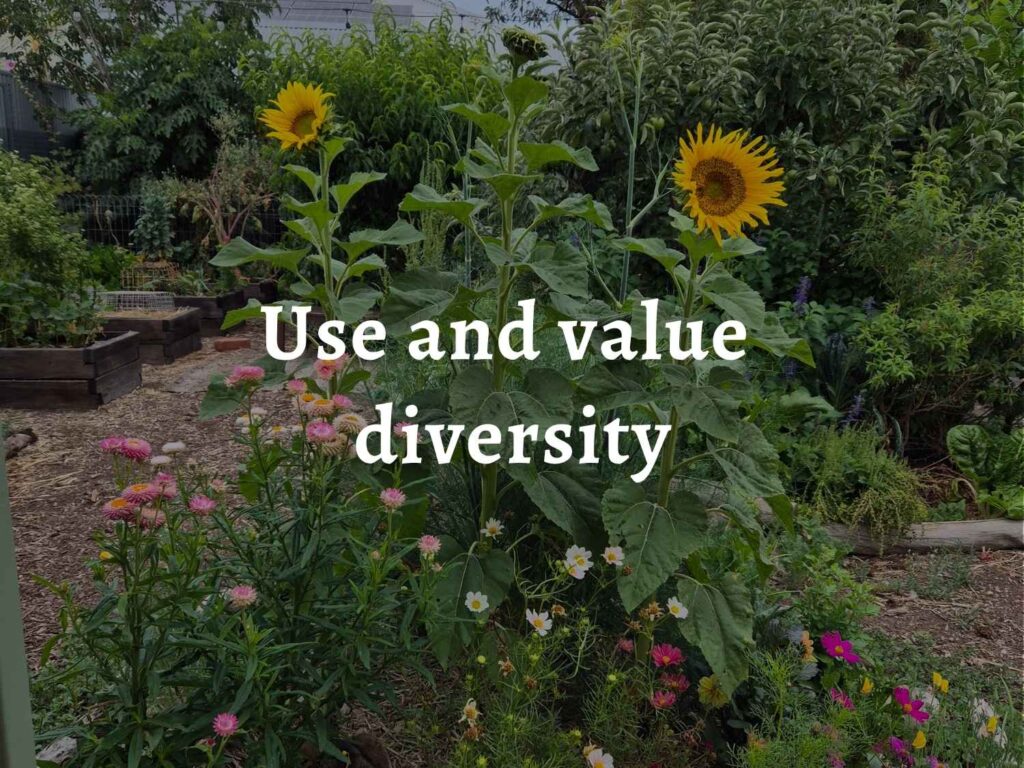
What ‘use and value diversity’ means
While the permaculture principles were originally developed to guide the design of farms and gardens, they’re actually universally applicable. Let’s look at the traditional definition, then reimagine what ‘use and value diversity’ means for ethical business and marketing.
Land-based definition
Design landscapes and livelihoods as polycultures with multiple diverse elements that together become more resilient, adaptable and able to weather storms.
Marketing definition
Build resilience by spreading marketing efforts across an interconnected mix of income streams, offers and tools, reducing risk and offering stability even if one element fails.
Proverb
Don’t put all your eggs in one basket — reminding us that diversity offers a safeguard against variations in our environment.
Translating this principle to marketing
Diversity is like insurance, a back-up plan that offers resilience and stability when something goes wrong. It can help us survive wobbly times and better weather rough storms, and may even smooth out business cycles of feast and famine.
Yet modern marketing “gurus” often advocate for monocultures: one signature offer or product, one key marketing tactic, one main audience or clientele.
This level of simplicity can be efficient and helpful when starting out. But just like monocultural agriculture, it’s fragile longer-term — an algorithm change or market shift can destabilise the whole business and thus your precious livelihood.
‘Use and value diversity’ invites us to instead cultivate a strategic marketing polyculture that has multiple income streams, pathways and connection points, mimicking natural ecosystem diversity.
Diversity isn’t about doing everything, everywhere, all at once
I’m not advocating for hustle-culture’s “be everywhere” marketing approach. That will probably leave you burnt out from haphazardly maintaining 16 different channels that somehow don’t make a jot of difference to your biz bottom line.
Beware of spreading yourself too thin by adding too much diversity or haphazardly stacking up random income streams and marketing tools in a way that’s incongruent to your audience.
Instead, it’s about working with a carefully selected and minimalist mix of marketing elements – and focusing closely on how they each interconnect, providing backup if one element fails.
That’s a way to mirror living systems, where stability comes from beneficial relationships between species that support one another, rather than the sheer quantity of species themselves.
The same applies in marketing: a diverse set of offers or channels only strengthens your business when they are meaningfully connected — for example, when entry-level offers feed into deeper work, or when different platforms support the same key messaging and values.
So, go slow. Take a minimalist approach.
Look to stack functions by choosing new elements or tools that increase the beneficial relationships between existing elements of your marketing system, so that together they synergistically support one another.
You might also mimic natural succession by approaching diversity in an iterative way, where each new element you add helps lay the foundation for what comes next.
Embrace experimentation as you diversify
‘Use and value diversity’ also promotes the importance of experimentation.
We can’t know in advance what definitely will and won’t work. Marketing strategy is largely a hypothesis until you test your ideas in the real-world market. So, have a go and gradually test different things: different offers, marketing platforms, ways of explaining your work.
Over time, the most useful and sustainable approaches will become clear, and you can ditch or revise options that didn’t perform so well.
“This proliferation of diversity followed by culling is a fundamental pattern of nature… without experimentation, we do not know what the possibilities are.”
— David Holmgren, Permaculture: Principles and Pathways Beyond Sustainability
How to apply ‘use and value diversity’ in marketing
We can cultivate diversity both within our business structures and through the people and perspectives we make space for.
Create diversity in your business model and marketing strategy
- Build multiple pathways for people to find, trust and buy from you.
- Avoid single-point dependence (one platform, one offer, etc) where possible.
- Design offers that connect and support each other.
- Create more than one way for people to begin working with you, and allow people to move through your work non-linearly if they choose.
- Consider ways to bring in multiple income streams, providing resilience if one dries up.
- Experiment with small variations in content, offers or formats before scaling.
- Regularly review what’s working, then simplify by pruning what isn’t.
Make space for diverse perspectives and people
- Actively seek and amplify perspectives beyond your own lived experience.
- Avoid assuming that your community is homogeneous in background, culture or values.
- Design offers that challenge ableist and productivity-driven norms, and that serve different depths, timelines or learning styles.
- Consider using sliding scales, scholarships, payment plans or pay-what-you-can to make your work more accessible.
- Use captions, transcripts, alt text, clear layouts and accessible brand colours so people of all abilities can understand your work.
What permaculture thinkers say about this principle
“One of the most important lessons we can learn from the natural world is that diversity is the key to health and resilience.” — Heather Jo Flores, Free Permaculture
“Diversity creates stability.” — Aranya, Permaculture Design
“Prioritising diversity and polycultures is how we reduce our financial vulnerability while bolstering household and community self-reliance.” — Laura Oldanie, Permaculture and Money
“Diversity needs to be useful and linked to a system’s capacity to operate and evolve. Useless diversity is a wasted resource and a drain of energy. When we design, we use diversity wisely.” — Meg McGowan
“Polycultures are built on the premise of symbiosis; different plant niches will help one another to flourish. This highlights each plant’s value, celebrating differences and their ability to benefit everyone in the system. In this way, nothing is lacking, there is room for all to grow, and no one has to break their back to make it happen.” — Maya Blackwell, Permaculture
Other closely connected principles
The 12 permaculture principles work best as a set of interconnected design prompts.
Each offers a different lens, and the combination creates depth, balance and a tempering effect — the holistic approach at the heart of systems thinking.
For example, ‘use and value diversity’ is closely related to:
- Principle 4, ‘apply self-regulation and accept feedback’, as adding or pruning elements in your marketing system requires regularly tuning into feedback loops.
- Principle 8, ‘integrate rather than segregate’, as diversity in your marketing toolkit works best when each element is carefully selected to maximise beneficial relationships.
- Principle 9, ‘use small and slow solutions’, which serves as a reminder to move step-by-step, at ‘human scale’, rather than trying to do everything all at once.
Ready for the next principle? Browse the full series here.
And a quick side note: this series is adapted from a lesson inside my Permaculture Marketing course, in case you’d like to go deeper.
Share this with your mates
About the Author: Koren Helbig

About the Author: Koren Helbig