If we want to build genuinely ethical businesses and marketing practices, I believe we must start with something fundamental yet often overlooked — a shared understanding of what ‘ethical’ means.
Without the common ground of a clear definition and code of behaviour, ‘ethical’ can become a slippery word, liable to getting stretched or co-opted by greenwashers.
This is where the three ethics of permaculture come in: a brilliantly holistic framework grounded in ancient wisdom that shifts our thinking beyond the individual to the collective, and that any business can use.
Using the three permaculture ethics as a moral code for business and marketing
The three permaculture ethics of Earth Care, People Care and Fair Share are a core moral foundation that help you live and work more sustainably and holistically.
They’re like a universal moral code pointing you to a true north that benefits all.
While the ethics have traditionally guided the design of permaculture farms and edible gardens, they’re not only limited to land-based systems and lifestyles.
They’re actually universally applicable. So, they can provide a holistic moral code for ethical business and marketing, like a philosophical framework that guides your overall approach, attitude and behaviour.
This helps you develop values-aligned marketing strategies that are more regenerative, human-centred, kind and calm — a much-needed alternative to the manipulative and reductionist hustle culture of conventional marketing, which has left so many of us feeling awful and exhausted. (Uuugh, enough of that already, hey?)
Let’s take a close look at the three ethics of permaculture, what they mean, how they interact with your own personal values and how they can help small business owners, sole traders, entrepreneurs and impact-driven businesses create more ethical marketing strategies.
And a quick side note: this article is adapted from a lesson inside my Permaculture Marketing Course, in case you’d like to go deeper.
What are the permaculture ethics, and how can they be applied to ethical marketing?
When permaculture was first conceptualised in the 1970s, Australians Bill Mollison and David Holmgren defined three foundational ethics that have largely remained unchanged since.
The three ethics of permaculture are:
- Earth Care (protect and regenerate the natural world): Recognise that all life on Earth depends on a healthy planet, which we must actively care for and nurture by protecting ecosystems, enhancing biodiversity and restoring soil, forests and waterways.
- People Care (provide for self, kin and community): Work collaboratively to ensure that everyone is taken care of, from our own selves to our families, neighbours, the wider planetary population and even other species, creating more resilient and empowered communities.
- Fair Share (set limits and redistribute surplus): Manage resources responsibly by reducing consumption of ‘stuff’, taking only what is needed and allocating surplus time, money, energy and materials back into the first two ethics, while also recognising limits to how much we can sustainably give.
Really, these ideas aren’t new.
The thinking encapsulated within these ethics is found in many traditional and First Nations cultures that have maintained a continuing connection between people, land and nature throughout history.
This would once have been common knowledge to all of our ancestors.
But much of this knowledge has been sidelined or lost to the fast, productivity- and profit-driven pace of modern life. So, permaculture and its ethics offer us a pathway back to ancient wisdom and truly sustainable living.
Reimagining the three ethics of permaculture for marketing
In bringing the permaculture ethics into a purpose-driven business and marketing context, I’ve refocused each definition more squarely on how it can be applied to ethical marketing.
The three Permaculture Marketing ethics are:
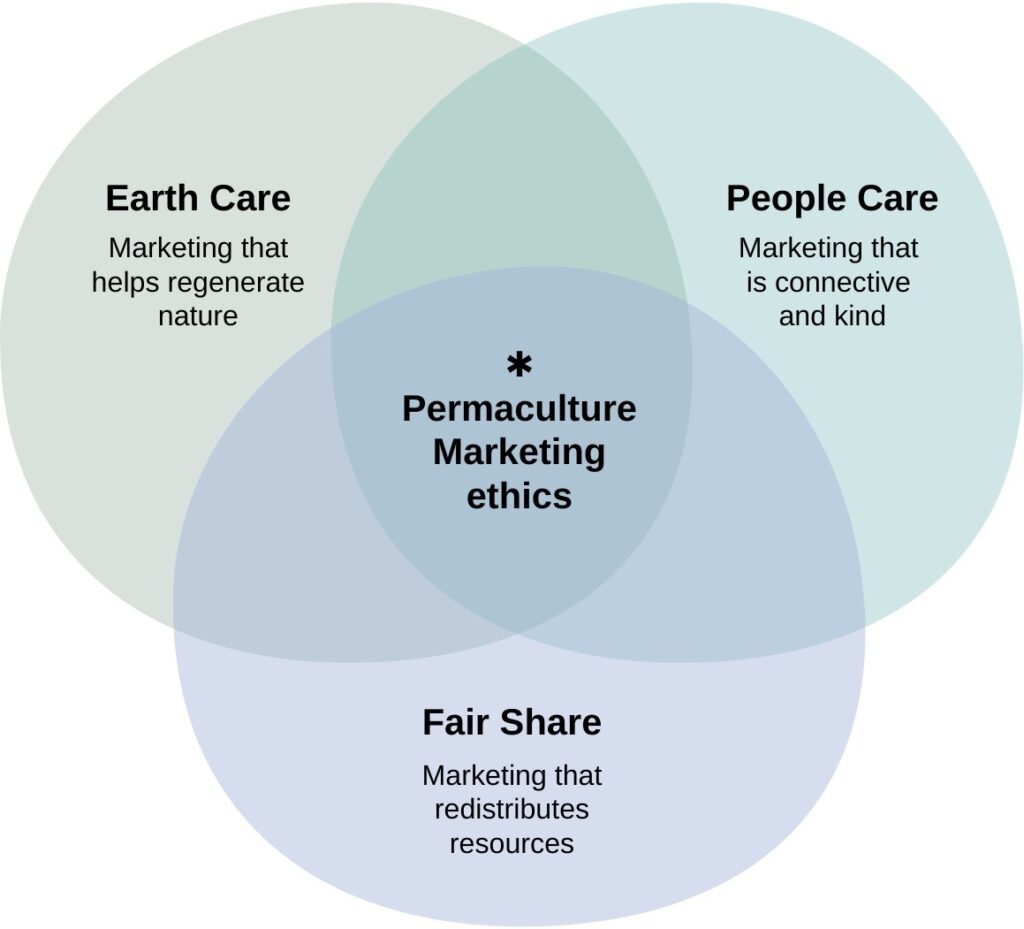
- Earth Care (marketing that helps regenerate nature): Actively look for ways to make your business and marketing lighter on the planet, while promoting environmental protection and regeneration.
- People Care (marketing that is connective and kind): Prioritise wellbeing for everyone your business and marketing touches: your audience, customers, collaborators and even yourself and other more-than-human species.
- Fair Share (marketing that redistributes resources): Promote your business and offerings in ways that create mutual benefit and fair exchange, while allocating a sustainable amount of your profits, time or resources for the greater good.
These ethics have become the foundation of my own marketing business and are regularly adopted by my small business clients, too.
They help you cultivate a whole-systems thinking approach to marketing.
Because used together, the ethics help you to see your business and marketing as an interconnected part of a larger whole, where every decision you make creates ripples beyond your own immediate goals and needs.
In fact, the three permaculture ethics are usually drawn as a Venn diagram of overlapping circles, as they are very much interrelated and interconnected — actions you take or problems that arise within one ethic will often affect the other two.
Practical examples of applying the three permaculture ethics in your marketing
So now you might be thinking: great, but what does this all look like in practice? Here are a few ways these ethics of permaculture might show up in everyday marketing decisions.
Earth Care
Earth Care invites us to think beyond short-term profit and consider the long-term ecological impact of our work.
A good foundational thinking tool is the Seventh Generation Principle, which involves asking yourself: What might the environmental and social impacts of this decision be for my great-great-great-grandchildren?
In marketing and business, Earth Care might look like:
- Aligning promotions with your values by only marketing products, services or partnerships that genuinely reflect your ethics.
- Being transparent about imperfections and openly acknowledging where your business isn’t yet fully sustainable, rather than resorting to greenwashing.
- Educating your audience about environmental issues in your industry and how they can make more informed choices.
- Conducting an environmental impact audit to analyse how you procure resources, make products, package goods and deal with waste.
- Thinking long-term when making business decisions, prioritising durability and regeneration over short-term gains.
People Care
People Care reminds us that businesses are ultimately about relationships — with our customers, collaborators, communities and even ourselves and other more-than-human species.
In practice, this might look like:
- Marketing with genuine empathy by understanding your audience’s needs, challenges and hopes, and communicating in ways that are helpful rather than predatory.
- Respecting consent and inviting people into your offers rather than pressuring them with manipulative tactics, fake scarcity or exaggerated claims.
- Prioritising accessibility, inclusivity and honesty in how you communicate, ensuring your marketing is welcoming to a diverse range of people.
- Listening deeply to customer feedback, including complaints, and using that information to improve your products and services.
- Focusing on community over competition by collaborating, cross-promoting and celebrating others in your network.
- Caring for yourself as a business owner by choosing marketing methods that feel sustainable for your unique capacity, energy and nervous system.
Fair Share
Fair Share encourages us to think about the equitable distribution of resources — taking what we need while ensuring there is enough for others and future generations.
Fair Share in marketing and business might include:
- Embracing “enoughness” as a guiding business principle and aiming for a healthy, sustainable income rather than endless accumulation.
- Balancing earning and giving by building a financially stable business first, then circulating value back into the wider community rather than hoarding it.
- Using profits for good by donating to charities, ‘Paying the Rent‘ to indigenous organisations and supporting regenerative initiatives.
- Offering pro bono work or discounted services to non-profits, grassroots groups or community organisations.
- Creating accessible pricing options, such as payment plans, scholarships or sliding-scale pricing where you can.

Go deeper: Apply the permaculture ethics in your marketing using the 12 permaculture design principles
The ethics serve as an overarching philosophical framework, but they are deliberately high-level and broad. To apply them in day-to-day life, we need a more detailed toolkit.
That’s where the permaculture principles come in.
The 12 permaculture principles are practical thinking tools that help you test ideas and make good decisions, ensuring that any real-world action you take aligns with the three ethics.
In other words, ethics are the ‘why’ or foundational moral code, whereas principles are the ‘how’ or tools for designing functional marketing systems.
Permaculture ethics versus permaculture principles: a comparison chart
| Ethics | Principles | |
| Focus | Foundational moral code (‘why’) | Functional design tools (‘how’) |
| Components | Earth Care, People Care, Fair Share | 12 design principles |
| Purpose | Guides purpose and attitude Philosophical, broad | Guides action and decision-making Technical, specific |
| Analogy | The rules of the game | The strategy to play |
Why permaculture ethics are crucial in sustainable marketing and business-for-good
I like to think of ethics as the soil from which everything else in your business and marketing grows.
If the soil is poor or toxic, nothing thrives. If it’s pumped up with synthetic fertilisers (ie, inegnuine claims based on false ethics), things might grow rapidly at first, but tend to slow down and even die in the long-term (ie, people start to see through greenwashing and choose to spend their money elsewhere).
If the soil is healthy, nurtured and understood as the foundation from which healthy and resilient life grows, everything else becomes easier and more productive.
This is why I believe for-purpose businesses need to start with ethics — and the permaculture ethics of Earth Care, People Care and Fair Share provide a brilliant holistic framework based on traditional wisdom and knowledges.
Stephen Covey (The Seven Habits of Highly Effective People) describes this as “beginning with the end in mind”, as ethics become the frame of reference through which you examine your decisions and behaviour going forward.
“By keeping that end clearly in mind, you can make certain that whatever you do on any particular day does not violate the criteria you have defined as supremely important, and that each day of your life contributes in a meaningful way to the vision you have of your life as a whole,” Covey writes.
How the ethics of permaculture help your marketing
When permaculture thinking and ethics are consistently embodied in your everyday thinking and behaviour, your business and marketing inevitably benefit in the long term.
The ethics help:
- Provide a moral foundation for good choices: As Looby Macnamara writes: “Each ethic has a range of meanings and subtleties that enable us to see more deeply into our choices, assess impacts and find options with multiple benefits. They help us manifest an attitude and way of thinking that leads us to develop skills and tools within each ethic.” (People and Permaculture, page 4.)
- Build trust and credibility: Clear ethics show people what your business stands for. When your actions consistently reflect your ethics and values, you build a business that feels honest, trustworthy and human — which naturally attracts more like-minded clients and aligned opportunities.
- Create a positive ripple effect: Ethics guide you to consider the wider system — your clients, community, other species and the entire planet. By making choices that are fair, sustainable and people- and planet-centred, your marketing becomes a force for wider positive impact, rather than just focusing on sales and profit as the key success metrics.
The next step: Layer your own business core values atop the three permaculture ethics
I believe every business that seeks to be regenerative or for-purpose would do well to embody the three permaculture ethics, at the very least.
They’re holistic, systems-focused, grounded in ancient wisdom and they help you do business in a way that honours the quadruple bottom line: purpose, people, planet and profit.
But you likely also have personal or professional interests and core values that lie close to your heart. That’s why I recommend creating your own set of business values that sit atop the three ethics of permaculture.
These business values can really encapsulate anything that’s important to you; any way of being in the world that you want your business to embody.
How to create your business core values
Keep it to three or four business values, maximum. Any more and they become hard to remember — and if you can’t remember them, you’ll struggle to embody and apply them consistently in your day-to-day decisions.
For each value, I recommend choosing just a few simple words that clearly capture its essence.
Then write a sentence or two that clarifies what each value means to you, or how you intend to embody that value in your business.
For example, my own business values are:
- Inner-led wisdom: You know your business best, I’m here as a guide. We blend what feels right for you with marketing science and data to design solutions that match your capacity and values.
- Honest kindness: I communicate clearly and directly (hello, neurodivergence) but always with deep care and respect, so our work together feels safe, constructive and empowering.
- Nature’s pacing: We mimic the natural world and move at a steady, sustainable pace, designing marketing that’s calm, holistic and at least a bit enjoyable, rather than robotic, rapid and manipulative.
- Fun! I believe business can and should be energising, playful and fulfilling. That’s the approach we’ll take to both my work and yours, while ensuring everything’s high-quality and effective.
As you can see, these business values sit beautifully atop, and complement, the three permaculture ethics of Earth Care, People Care and Fair Share.
UK purpose-led business coach Alan Wick defines values in a business context as “a roadmap for behaviour”.
“In other words, how do you want to behave in your business to maximise your chances of success, and how do you want your managers and staff to behave when they’re out of your sight?”
He goes on: “Expressed as a formula, I believe that Purpose + Core Values = the ‘DNA’ (or ‘Culture’) of a business.”
I agree, but would build on this: Permaculture Ethics + Values + Purpose + Permaculture Principles = Your Business Culture
This is just a brief introduction to articulating your business values and purpose as part of ethical marketing strategy design — the full process is explained step by step via videos and fillable workbooks inside my Permaculture Marketing Course.
The interconnected framework that creates a regenerative business and marketing culture
Now you have a foundational understanding of how the three ethics of permaculture apply to marketing — and how they form part of an interconnected framework that together make up the culture of a regenerative business and ethical marketing approach.
To recap:
- Permaculture ethics are the universal, moral ‘why’ that guides all actions; the foundational compass that sits beneath everything else.
- Business values are your personal or professional ‘why’ that outlines the things most important to you.
- Business purpose is the overarching ‘why’ of the business itself; the ultimate reason your business exists in the world or what it broadly aims to achieve, beyond just making money.
- Permaculture principles are the actionable ‘how’; the practical thinking tools that help you make real-world decisions aligned with ethics, values and purpose.
In other words:
- Ethics = universal moral code
- Values = professional moral compass
- Purpose = core reason your business exists, beyond profit
- Principles = practical tools to put all of the above into action
And remember: Ethics + Values + Purpose + Principles = Your Business Culture
Once you have all of these elements drafted for your business, go and tell folks about it.
Add them to your website, share snippets in blog posts and social media, articulate this worldview in podcasts, give a brief version to that person at a party who’s interested in what you do for a living.
Sharing your permaculture ethics, business core values and purpose helps people understand what you stand for, builds trust and makes it easier for the best-fit clients to connect with you and your offers — which ultimately expands your business’s capacity to do good in the world.
Related resources
- Permaculture Marketing Course — go deeper inside my guided course for purpose-driven small business owners, which includes an entire module on developing your business ethics and values.
- Permaculture ethics in business — Australian permaculturist Richard Telford outlines some practical ways he’s embodied the ethics in his own business.
- Permaculture ethics, corporate sustainability and the triple-bottom line — an interesting discussion on how corporate sustainability aligns with the three ethics of permaculture.
- Finding your values — a podcast episode offering multiple helpful inroads to uncovering your values, by Australian business mentor Laura Jean.
- How many core values should your company have? — copywriter Philip Morley advocates for ‘distillation’ as a core skill when creating business values; ie, be ruthless and pare them back.
- Holistic Decision Making — the late Australian permaculture designer Dan Palmer wrote this excellent three-part explainer on a more holistic way to uncover your values.
- Toward and away moves: A neurodivergent approach to values-based choices — American clinical psychologist Dr Megan Anna Neff explains a more gentle way to live by your values day-to-day.
Share this with your mates
About the Author: Koren Helbig

About the Author: Koren Helbig