

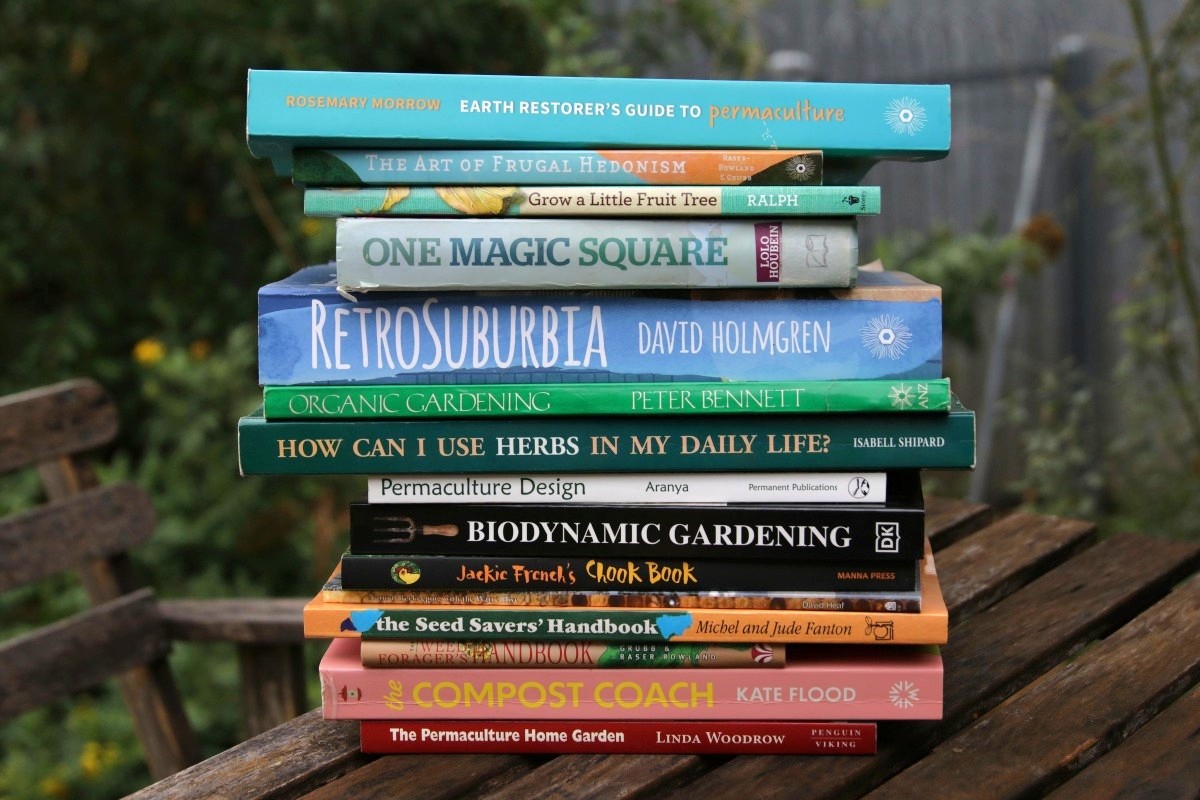
Any best permaculture books list is naturally based on the author’s subjective opinion, and this one is no exception. But I reckon you’ll find it useful nonetheless.
Because I read a lot, and I’ve been down a permaculture rabbit hole for almost a decade now.
I’m also a book minimalist. I’ll only purchase my own copy once certain I’ll refer to it repeatedly, after first testing out a borrowed version via friends or the library. Only the most useful books make it into my small for-keeps collection.
The permaculture books listed below are the best, the keepers, in my opinion. They’re all ones I now own.
I’ve found these books incredibly useful — again and again — as I’ve taught myself the complex and heartening world of permaculture, organic gardening and sustainable living. They’re a great place to start if you’re a beginner seeking info and understanding, or a more experienced permie wanting to deepen your skills.
A lot of these best permaculture books are Australian, like me. But they’re broadly applicable, no matter where in the world you live.
Enjoy!
(By the way, I’ve used the term ‘permaculture book’ rather loosely here. While some of the books aren’t specifically named or marketed as permaculture, they absolutely encapsulate permaculture thinking and skills.)
Best permaculture books to help you understand theory and principles
Essence of Permaculture booklet by David Holmgren (AUS)
For the quickest crash-course on ‘what the heck is permaculture?’, this free booklet is the go. It’s written by David Holmgren himself, who co-originated permaculture alongside Bill Mollison back in the 1970s. But unlike some of his meatier tomes, this one’s only 23 pages. It doesn’t require a huge time investment, but will give you a good working overview of permaculture’s three ethics and 12 principles.
Extra: The booklet is a conceptual summary of David’s bigger book, Permaculture: Principles and Pathways Beyond Sustainability, a good but complex read.
Earth Restorer’s Guide to Permaculture by Rosemary Morrow (AUS)
If you’re going to buy just one book, make it this one. It’s my absolute favourite ‘how to permaculture’ book — just the clearest, most straightforward explanation of what permaculture actually is and how to apply it. It’s written by Australian permaculture elder, Rowe Morrow, who has dedicated a lifetime to teaching permaculture around the world, including in refugee camps. She’s perfected the art of plain-English-explanations, complemented by useful illustrations on almost every page. Also includes a section on permaculture in communities, workplaces and cities.
Permaculture Design by Aranya (UK)
My second-favourite permaculture book, this one steps you through the full process of designing a permaculture garden or space from beginning to end. Along the way, you learn key permaculture concepts and tools, such as pattern recognition, sectors and zones, guilds, edge effects, energy cycling and appropriate scale — and how to get all that down onto a functional garden map. Don’t be put off by regular references to “clients”; you don’t have to be a professional designer to understand and use this brilliant book.
7 Ways to Think Differently by Looby Macnamara (UK)
This affordable little book is short and sweet, the kind of thing you could knock over in a day or two, but it contains powerful permaculture thinking tools for gardening, life and business. That includes abundance thinking, systems thinking, thinking like nature, cooperative thinking and more. It’s a helpful starter guide to broadening your mindset and therefore your capacity to imagine and create a different, more climate-positive lifestyle and future.
The Art of Frugal Hedonism by Annie Raser-Rowland & Adam Grubb (AUS)
This one’s like hitting a giant ‘reset’ button. It offers practical ways to shift away from consumerism, monetary spending and long work hours to more frugal ways of living, jam-packed with happiness, connection and freedom. I find it especially useful when my lifestyle hits uncomfortably up against other people’s expectations — when I get weird looks for not wanting to eat out at expensive restaurants every weekend, for example. There’s a cheaper, more creative and fun way to live, my friends…
Extra: Listen to Annie chat frugal hedonism on The Permaculture Podcast.
The Transition Handbook by Rob Hopkins (UK)
If you’re worried about climate change (and frankly, who isn’t these days?), read this. Rob focuses on the wider issue of ‘peak oil’ and all that means for our society. Happily, it’s not all depressing. Rob has pioneered the ‘Transition Town’ movement, beginning in the UK and now worldwide, where ordinary folks are reimagining and re-localising their own towns. Perhaps you might get excited enough to start the push for Transition Town conversion in your area?
The Permaculture City by Toby Hemenway (USA)
As a city-dweller myself, and given the rapid population growth in cities worldwide, I’m particularly interested in urban permaculture. This book offers the deepest dive currently available on permaculture in the city. Toby (who is no longer with us, sadly), looks at small-scale housing and gardens, urban streetscape and public space design, ‘right livelihood’ work and career options for city folk, and even ways to meet our needs (for food, water, etc) more sustainably by sidestepping harmful supply chains. I wish I lived in a city where everyone thought like this.
The Wilderness Garden by Jackie French (AUS)
This book gave me permission to garden messily, chaotically, to let plants trail here and fall there, and to grow things on top of each other in ways normally frowned upon. Jackie advocates this as perfect for Australia’s hot conditions, harsh sun and dry climate, which mean things don’t need as much space here. She writes: “We need to develop new styles of growing things that suit our country.” It’s so different from other ‘how-to-garden’ books. A game-changer. (Jackie’s Guide to Companion Planting is pretty great, too.)
Call of the Reed Warbler by Charles Massy (AUS)
Charles is a conventional farmer turned regenerative agriculture visionary. He’s also an exceptional, lyrical writer, which makes the complex themes of his book a delight to comprehend. After reading, it’s difficult to drive through rural and regional Australia, observing mass monoculture crops, chemically treated bare land and drought-scared landscapes — because it’s certain there’s a better way. Thanks to Charles and others like him, more farmers are slowly making the shift.
Extra: Watch Charles’ 2018 TEDxCanberra talk: How regenerative farming can help heal the planet and human health.
Best permaculture books to teach you practical skills and strategies
How Can I Use Herbs In My Daily Life by Isabell Shipard (AUS)
Easily my most-frequented book, this is a bible of herbs and medicinal plants, and how to use them at home. Don’t be put off by the giant wall of text on each page. The index is well set up for searching by plant or ailment, and the explanations are entirely thorough: a description of the plant, its vitamin and mineral content, medicinal uses and culinary uses. Plus descriptions on how to make the basics of herbal medicine: infusions, decoctions, macerations, poultices and creams.
Organic Gardening by Peter Bennett (AUS)
A great one if you’re gardening in South Australia — home to the late author, Peter Bennett — or other warm temperate climates. Peter details almost everything a veggie gardener needs to know: how to cultivate living soil, prepping and maintaining your organic patch, dealing with pests, alternatives to nasty chemicals, and then a hugely detailed plant-by-plant guide. First published in 1979, you can find vintage copies easily for a few dollars at op shops, or spend a bit more on the fancy new updated version.
Biodynamic Gardening by Monty Waldin (UK)
While permaculture offers a practical design toolkit for creating efficient systems based on the patterns of nature, biodynamics is more spiritual — and confusing as heck when you’re just getting started. This book helped me begin to make sense of it all. It clearly explains key elements, including how biodynamics began (in the 1920s, via Austrian philosopher Rudolf Steiner), how positions of the moon, other planets and stars affect plant growth on Earth, and how to make the BD preparations. Half the book is dedicated to each fruit and veggie, and specifically, how to grow them well using biodynamic principles.
The Seed Savers’ Handbook by Michael and Jude Fanton (AUS)
To learn effective fruit and veggie seed saving is to create local resilience. Plants grown at your place season after season adapt to your region’s climate and soil, while becoming more resistant to local pests. Plus, as supermarkets focus on an ever-smaller range of produce, you can help keep diversity in our food chain — from your own patch. This book teaches you, plant by plant, how to grow, save and store seed, and how long they’ll remain viable.
The Compost Coach, by Kate Flood (AUS)
I thought I knew how to compost… then I read this book. Kate breaks down the confusing world of composting into simple, easy-to-understand language that will have you turning food scraps into nutrient-rich soil like a pro in no time. Which is super important, because food waste dumped in landfill spews forth tonnes of toxic greenhouse gases as it rots, contributing to climate change. Composting at the home-scale — in bins, bays, bokashi, worm farms and more — is far more sustainable. Kate shows how it’s doable at any scale, big or small.
Extra: See my simple city garden composting system, inspired by tips in Kate’s book.
Jackie French’s Chook Book (AUS)
If you want chickens — heck, even if you already have them — please read this book. It’s hands-down the most informative, practical and no-nonsense guide. Jackie’s kept chooks for decades and shares everything you need to know, from breed selection and coop ideas to what and how to feed, spotting common problems and diseases, and even recipes — for both eggs and chicken. And all in Jackie’s signature brand of writing: wittily matter-of-fact.
Natural Beekeeping with the Warré Hive by David Heaf (UK)
If you’d like to become a beekeeper, this is a must-read. Warré beekeeping (named after its French inventor, Émile Warré) attempts to mimic how bees live in tree trunks. The goal is minimal human interference, with natural bee behaviours allowed — unlike other forms of modern beekeeping, which share many of industrial agriculture’s not-great hallmarks. This book gives you the practical nuts-and-bolts details of how natural beekeeping works.
Extra: Download (free) Beekeeping for All, the 1948 book written by Émile Warré himself.
The Art of Fermentation by Sandor Katz (USA)
Humans have fermented food and drinks since the dawn of history, but too few of us know how these days. Time to re-skill. Fermentation preserves food and makes it more digestible, less toxic and more delicious. It’s simple to do at home — and this book shows you just about every possible method for veggies, milk, grains, legumes, meat, eggs, fish, mould cultures, alcohol and even fermented potpourri.
Extra: Browse my blog posts about fermenting and preserving.
Modern Mending by Erin Lewis-Fitzgerald (AUS)
Extending the lifespan of your clothes by mending helps reduce landfill, save money and decrease demand for new clothes. Erin’s approach is extra special, as she advocates ‘visible mending’ — beautiful, artful mends that you can visibly see on the outside of clothes. This tends to spark much-needed conversations about how easy mending can be. The book provides all the techniques you’ll need, complete with beautiful photos visually showing each step (with Erin’s ginger cat’s paw at times adorably used for scale). It’s like a cookbook for mending.
Extra: Check out Erin’s Modern Mending online store, full of carefully curated, ethical mending supplies and more good mending books.
A few more top permaculture books that will serve you well…
- Retrosuburbia by David Holmgren (AUS)
- The Permaculture Home Garden by Linda Woodrow (AUS)
- One Magic Square by Lolo Houbein (AUS)
- Grow A Little Fruit Tree by Anna Ralph (USA)
- Down to Earth by Rhonda Hetzel (AUS)
- Waste Not by Erin Rhoads (AUS)
- The Weed Forager’s Handbook by Annie Raser-Rowland and Adam Grubb (AUS)
Why bother learning permaculture in these turbulent times?
With the climate crisis worsening day by day, global politics careering in troubling directions, artificial intelligence opening the door to some truly terrifying tomorrows and the cost of living spiralling sky-high, it’s easy to feel overwhelmed and disempowered. Trust me, I feel you.
The trajectory isn’t great, but a dystopian future isn’t set in stone.
We can collectively make choices and learn skills now that help us reimagine the future to create a better pathway forward — and permaculture offers a holistic nature-based framework for doing just that, in your garden, home, community, workplace and far beyond.
Yes, we needed this change decades ago. But the next-best time to start is right now.
Permacutlure also helps us cultivate Active Hope (oh hey, that’s another book recommendation for you), which is the practice of taking concrete steps toward the beautiful future you dearly hope will eventuate, even while feeling the deep pain and grief of present reality.
That’s perhaps the most crucial skill we can all develop to cope during turbulent times.
Any must-read books you’d add to this list?
I’m always keen for recommendations and would love this blog to become a community-sourced bit of wisdom on the best permaculture books to read and learn from.
If you’ve happened across something brilliant lately, please pop the title and author in the comments below, so we can collaboratively build this permaculture book list together.
Share this with your mates
About the Author: Koren Helbig

About the Author: Koren Helbig



Thank you for sharing!
Our friends bible is Back to Basics: A Complete Guide to Traditional Skills by Abigail Gehring
Ohh, that’s a new one to me, thanks for the reco, Meg. I’ll definitely check it out :)