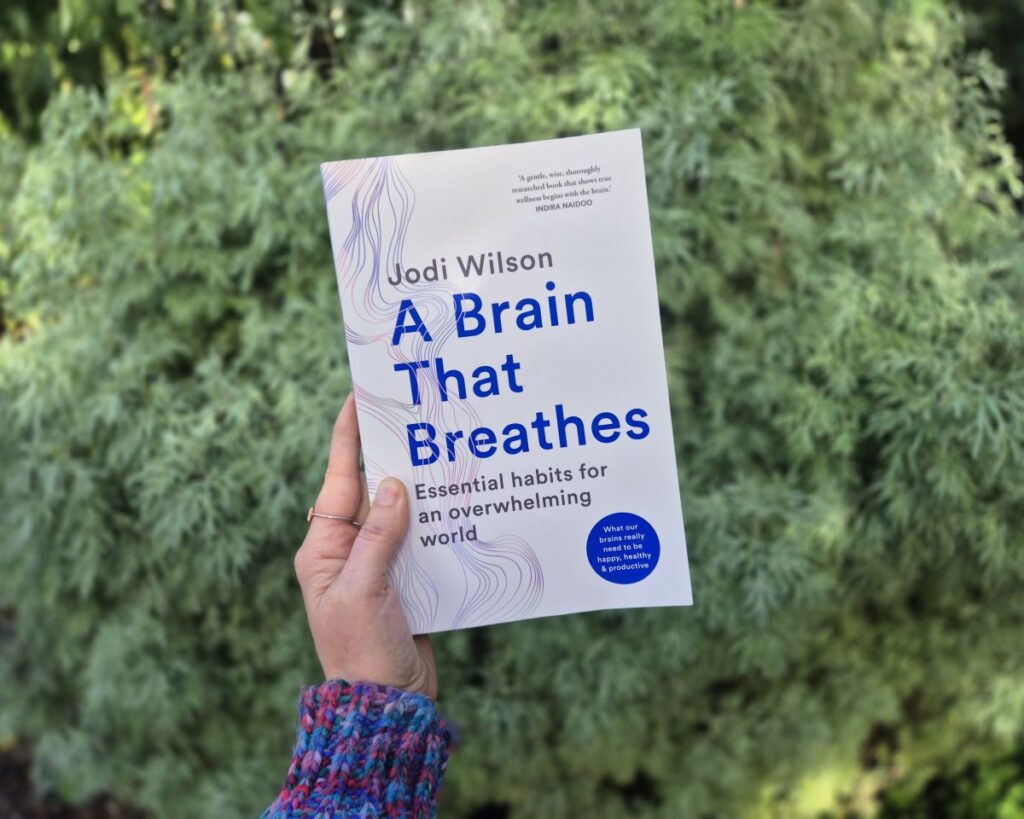
I’m in a book! Specifically, the lovely new book, A Brain That Breathes by Jodi Wilson, aka Practising Simplicity.
I was surprised and beyond chuffed when Jodi touched base back in 2024, keen to chat about my approach to creating more breathing space in life and work.
For the past 15 years, I’ve been slowly paring my life back to a few core essentials that meet my needs (financial and otherwise) while allowing plenty of time for resting, gardening, music, reading, friend hangouts and all the other fun bits that usually get swept aside when work becomes all-consuming.
People often look at my life now and tell me I’m “lucky”.
And yes, there is an element of privilege to my circumstances, considering I’m white, well-educated and somewhat able-bodied.
But concurrently, I have made many conscious choices, big and small, sacrifices sometimes too, to arrive here.
Chatting with Jodi was a chance to briefly relive that pathway — from starting a podcast so I could chat with women living the kinds of free and unconventional lifestyles I dreamed of, to quitting my corporate job and launching my own ethical small business, to embracing a four-day work week as I became a solo homeowner, and now to building a little urban permaculture food garden and frugally hedonistic life.
“Helbig creates balance between work and rest, is clear about what she wants, and has spent the past decade in pursuit of less for a life of more, honing her skills so her lifestyle embodies and reflects her values… She’s chosen to live frugally because it gives her autonomy,” Jodi writes.
Which feels like a pretty bloody good summary of what I’ve intended to build for my little life.
Jodi chats to loads of other brilliant and interesting people in A Brain That Breathes — neuroscientists, psychologists, artists and sustainable living experts.
The result is a book full of evidence-based, practical habits for cultivating more space and free time in your life.
Available at your local library (probs) and all good book stores, as they say.
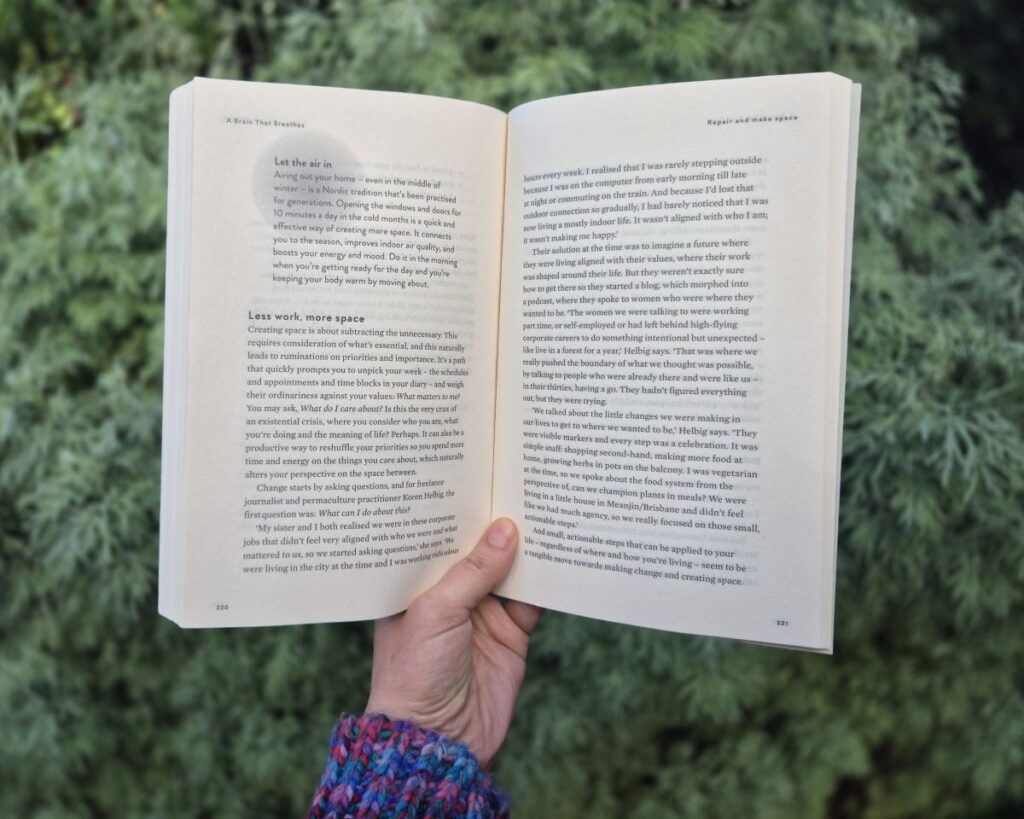
An extract from A Brain That Breathes (featuring me!)
Less work, more space
Creating space is about subtracting the unnecessary. This requires consideration of what’s essential, and this naturally leads to ruminations on priorities and importance. It’s a path that quickly prompts you to unpick your week – the schedules and appointments and time blocks in your diary – and weigh their ordinariness against your values: What matters to me? You may ask, What do I care about? Is this the very crux of an existential crisis, where you consider who you are, what you’re doing and the meaning of life? Perhaps. It can also be a productive way to reshuffle your priorities so you spend more time and energy on the things you care about, which naturally alters your perspective on the space between.
Change starts by asking questions, and for freelance journalist and permaculture practitioner Koren Helbig, the first question was: What can I do about this?
‘My sister and I both realised we were in these corporate jobs that didn’t feel very aligned with who we were and what mattered to us, so we started asking questions,’ she says. ‘We were living in the city at the time and I was working ridiculous hours every week. I realised that I was rarely stepping outside because I was on the computer from early morning till late at night or commuting on the train. And because I’d lost that outdoor connection so gradually, I had barely noticed that I was now living a mostly indoor life. It wasn’t aligned with who I am; it wasn’t making me happy.’
Their solution at the time was to imagine a future where they were living aligned with their values, where their work was shaped around their life. But they weren’t exactly sure how to get there so they started a blog, which morphed into a podcast, where they spoke to women who were where they wanted to be. ‘The women we were talking to were working part-time, or self-employed or had left behind high-flying corporate careers to do something intentional but unexpected – like live in a forest for a year,’ Helbig says. ‘That was where we really pushed the boundary of what we thought was possible, by talking to people who were already there and were like us – in their thirties, having a go. They hadn’t figured everything out, but they were trying.
‘We talked about the little changes we were making in our lives to get to where we wanted to be,’ Helbig says. ‘They were visible markers and every step was a celebration. It was simple stuff: shopping second-hand, making more food at home, growing herbs in pots on the balcony. I was vegetarian at the time, so we spoke about the food system from the perspective of, can we champion plants in meals? We were living in a little house in Meanjin/Brisbane and didn’t feel like we had much agency, so we really focused on those small, actionable steps.’
And small, actionable steps that can be applied to your life – regardless of where and how you’re living – seem to be a tangible move towards making change and creating space.
It reminds me of Anne Morrow Lindbergh, who writes in her book Gift from the Sea, ‘But neither is the answer in dissipating our time and energy in … more accumulations which supposedly simplify life but actually burden it, more possessions which we have not time to use or appreciate, more diversions to fill up the void.’
On her email signature, Koren Helbig highlights her working days (Monday to Thursday). She’s consciously chosen to work part-time, even though she has a mortgage to pay and lives in the city. All her lifestyle choices, from working part-time to being self-employed and living in a 100-year-old house with a small garden, have been thoughtful ones. You could say she views life – and living – through a permaculture lens, where she has created intentional breathing space for herself.
The former political journalist has not always lived like this. And perhaps that’s why she’s the best example of change: she figured out the steps she needed to take to live intuitively, with ample breathing space available to her, and she set about making it a reality.
‘I wanted to subtract this career from my life,’ she says, ‘but in order to be able to do that, there had to be an incubation period that was really internal, or at least in my internal circle – my sister, my family and a few choice friends who would support me and build it up.’
‘Your fragile idea needed breathing space to grow strong?’ I ask.
‘Yes, exactly that.’
But even turning that idea into concrete plans needed breathing space to come to fruition, free from the opinions and assumptions of others. ‘My idea needed to be more solid before I told many people about it,’ she explains. ‘Similar to when you germinate a seed inside on the windowsill before you transplant it out into the weather to harden off.’
Her idea is now a reality, and she admits that the smallness of her city life has created the opportunity – and the space – for mental, emotional and energetic reprieve. ‘The house is small, 87 square metres. The block is small – 478 square metres. I knew they wouldn’t be onerous or expensive or time-consuming to care for, which would allow me to have breathing space – rest, connect with my wider community, do other things.’
So what does breathing space mean to her? ‘When I think of breathing space, I’m not only thinking of resting time, but of things in my life that help me to feel generally calm, because that’s what allows me to feel like I have room to move,’ she says.
‘It’s all about doing it your way, and often that means consciously stepping to the side – which is hard, because you’re watching everyone else carrying on ahead of you – and trusting that the small steps you’re taking are in the direction that feels best for you. There’s fear of missing out and also fear of failing to keep up, but that’s actually a good question to ask yourself: Who am I keeping up with? And do I really care? Of course, there’s also the opportunity to find more joy and contentment when you do things your way, and it’s likely you’ll also connect with plenty of people choosing to live the same way.’
Helbig creates balance between work and rest, is clear about what she wants, and has spent the past decade in pursuit of less for a life of more, honing her skills so her lifestyle embodies and reflects her values. She lives in a small house with an abundant garden, a cat and a small brood of chickens. She’s chosen to live frugally because it gives her autonomy. Quoting Alys Fowler’s Eat What You Grow, she refers to her rambling garden – a place she has planned and tended for three years – as her ‘wild bit of the world’, her ‘tiny slice of reciprocity with nature’. Her life (and her work) is rooted in the pillars of permaculture: a self-sufficient lifestyle where resources – food, heat, light, energy, time – are valued and used mindfully.
So how did she plan to work part-time? She got practical. She, like Jane Hilliard, knows exactly how much she needs to earn to live well, and that’s exactly how many hours she files into ‘work time’. It’s a clear boundary.
Share this with your mates
About the Author: Koren Helbig

About the Author: Koren Helbig