
Lesson 2: Systems thinking & permaculture
Systems thinking lies at the heart of Permaculture Marketing. It’s like a lens that we’ll repeatedly look through when designing your marketing approach and strategy. Here’s a simple definition:
Systems thinking is a holistic way of understanding the world.
It’s a process of zooming out to consider the bigger picture (the ‘whole’) before zooming in to make decisions on the smaller details (the ‘parts’).
Crucially, it also focuses on how individual parts influence and interact with one another, rather than viewing each part in isolation.
That’s a stark contrast to how the world is often viewed these days — and how much of modern marketing is taught. Sadly, individualisation and reductionism have become the flavour of the era.
For example, a conventional marketing guru might say, “You must send weekly emails to your list; that’s how to make more profit.”
But that reductionist approach doesn’t take into account your wider ‘whole’ — your business type, your product lifespan, your customer needs, the time and energy you have as a business owner, and how all the other marketing things you’re already doing might help or hinder these new weekly emails.
Sending frequent emails may indeed be the secret sauce to soaring profitability for some small businesses. But blindly accepting that ‘part’ as the answer in your situation, without first considering the wider ‘whole’ of your marketing, could also be a recipe for burnout, annoyed customers, falling sales and reduced impact.
What is a system?
Systems are all around us and even inside of us.
They can be biological and alive, such as a plant or animal, forests, the earth and even our human bodies and the many systems within us, such as our digestive and respiratory systems.
They can also be non-living, such as a factory, public transport systems, the economy, cities, corporations and governments.
What defines a system is the way a group of ‘parts’ within a ‘whole’ interact and interconnect to serve a specific purpose.
“A system isn’t just any old collection of things. A system is an interconnected set of elements that is coherently organised in a way that achieves something.”
— Donella Meadows, Thinking in Systems: A Primer
“A system’s [parts] can be physical objects that you can touch, such as the various parts that make up a car. The [parts] can also be intangible, such as processes, relationships, company policies, information flows, interpersonal interactions and internal states of mind: feelings, values and beliefs.”
— Karen and Craig Russon, The Permaculture Systems Thinking Handbook
Your marketing system
This course focuses on your marketing ‘whole’: all ‘parts’ that interconnect to promote your work for the purpose of sustaining a profitable, for-good business.
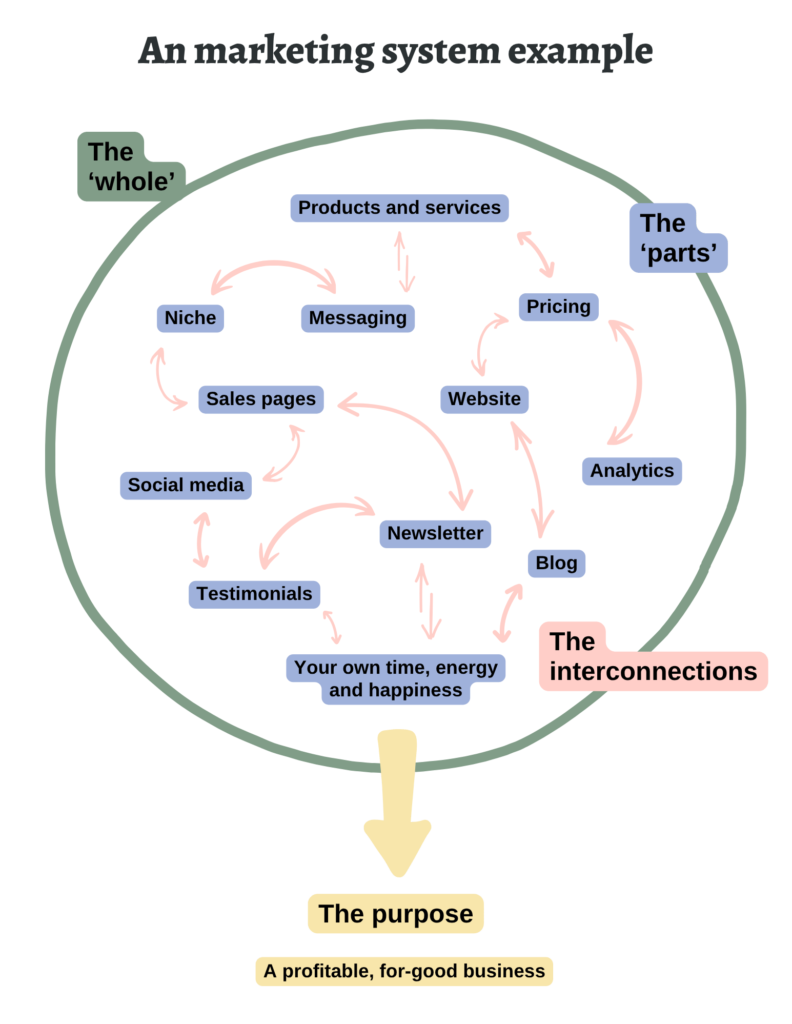
Whenever we refer to your ‘marketing system’, consider that a catch-all term for the many different ‘parts’ of your marketing.
The exact mix of parts will be different for each business, but may include:
- Your messaging, offerings and pricing
- Any tools you use, such as websites, newsletters, social media, blogging
- Analytics and data
- Word of mouth, testimonials and customer happiness
- Even your own energy, skills, capacity and happiness as a business owner
Instead of isolated tactics or short-term campaigns, we’ll explore how each of these marketing ‘parts’ influences and supports the others to make your business more profitable and impactful.
We’ll also consider how your marketing system influences much bigger systems beyond your business, too. We’ll explore that in more detail in the next module.
“The more we widen our view in this way, the more we see that everything — from the tiniest subatomic particle to the universe (and maybe beyond!) — is intertwined.”
— Karen and Craig Russon, The Permaculture Systems Thinking Handbook
How to use systems thinking
That was, admittedly, a rather simplified explanation of systems.
Systems thinking was first conceptualised in the early 1900s (although such thinking has been common for millennia among indigenous peoples) and has since been refined and adapted for a wide range of fields, including cybernetics, engineering, health, social sciences, biology, ecology and climate activism.
It now has a defined set of rules and thinking tools, such as stocks and flows, balancing and reinforcing feedback loops, leverage points, causality, self-organisation, emergence and more.
All of which are fascinating and useful — but also a bit esoteric.
It can feel hard to understand how to implement this stuff, especially in a marketing context, where systems thinking has rarely been deeply applied.
That’s where permaculture comes in.
What is permaculture?
Permaculture is a practical design approach, inspired by the laws of nature and indigenous knowledges, that helps you create more sustainable and resilient systems.
Essentially, it’s “the art of designing beneficial relationships,” as the late UK permaculture designer Patrick Whitefield succinctly put it.
Since the 1970s, permaculture has been used in gardens, farms and other land-based systems. But the philosophy and framework apply beautifully to any situation. This course is the first time (to my knowledge) that permaculture has been deeply applied to ethical marketing.
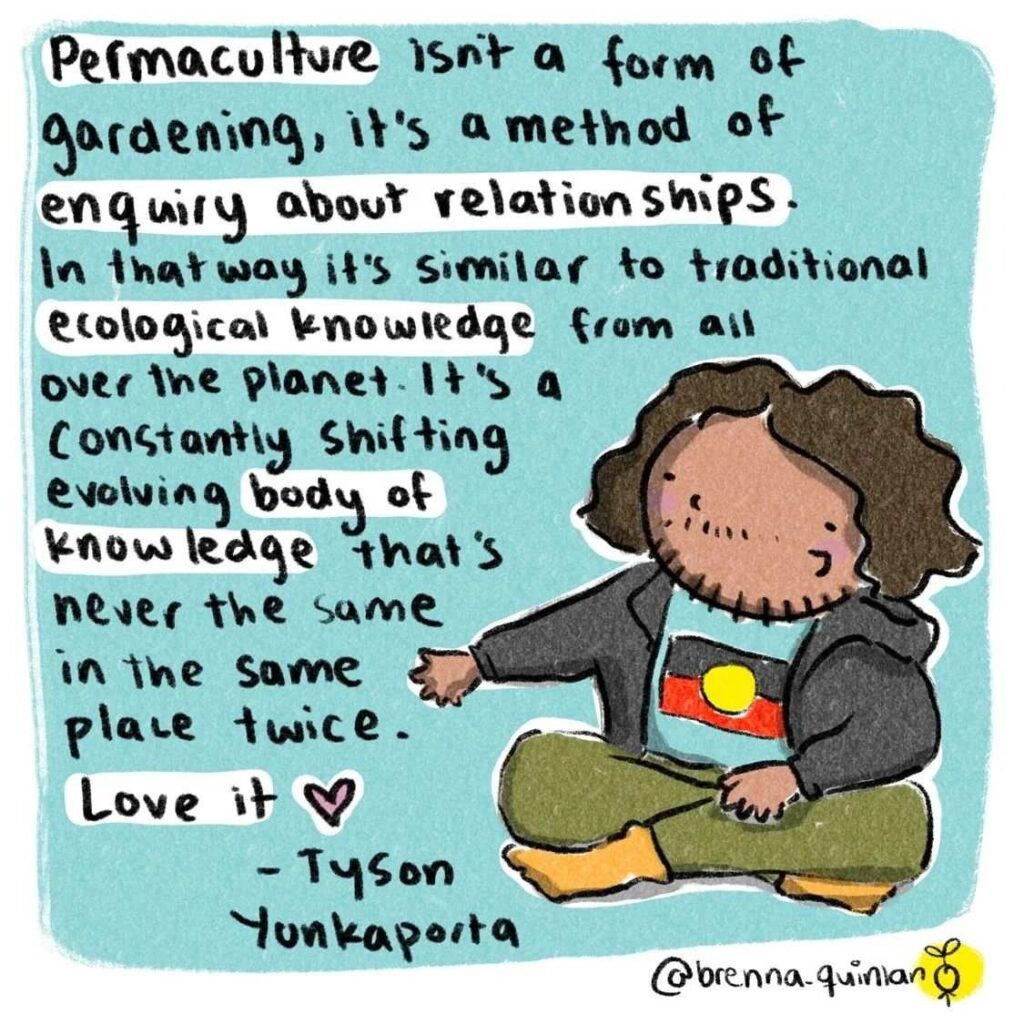
Permaculture is built on systems thinking.
So, permaculture offers us a brilliantly practical toolkit for making more empowering, holistic, systems-thinking-informed marketing choices.
It’s a way of using ecological thinking and language to repeatedly zoom in and out, considering the ‘whole’ and ‘parts’ from many different angles, which gives you the best chance of making more ethical and strategic marketing decisions.
This course offers you the skills to do just that.
Go deeper (optional)
You don’t need a huge understanding of systems thinking (or even permaculture, for that matter) to get started with Permaculture Marketing.
But if your interest is piqued, you may enjoy these deeper-dive resources:
- Introduction to Systems Thinking — a free PDF by American systems thinker and author Daniel Kim.
- The 6 Fundamental Tools for Systems Thinkers — a blog plus simple visuals by Leyla Acaroglu, an Aussie systems thinker and circular economy expert.
- Thinking in Systems: A Primer by Donella Meadows — a book that’s widely considered THE seminal guide to systems thinking, helpfully written in everyday language.
- The Century of Self — a one-hour documentary on the pretty yuck beginnings of public relations: first created by Sigmund Freud’s cousin Edward Bernays to manipulate the general public into more consumerism. A good one for understanding where marketing began so we can avoid this stuff in future. (Note: it’s very man-heavy; the film’s director apparently didn’t really consider or platform women’s perspectives 🙄)